


Page 62 - JCTR-9-4
P. 62
278                       Li et al. | Journal of Clinical and Translational Research 2023; 9(4): 272-281
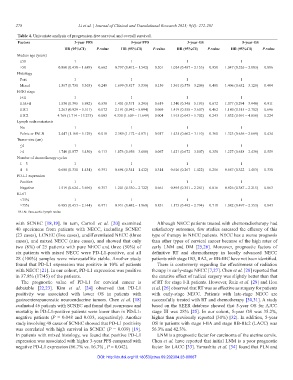
        Table 4. Univariate analysis of progression-free survival and overall survival.
        Factors                 3‑year PFS              5‑year PFS             3‑year OS              5‑year OS
                            HR (95%CI)   P‑value    HR (95%CI)   P‑value   HR (95%CI)   P‑value  HR (95%CI)    P‑value
        Median age (years)
         ≤50                    1                       1                      1                     1
         >50             0.860 (0.438 – 1.689)  0.662  0.797 (0.412 – 1.542)  0.501   1.024 (0.487 – 2.153)  0.950  1.047 (0.526 – 2.083)  0.896
        Histology
         Pure                   1                       1                      1                     1
         Mixed           1.567 (0.730 – 3.363)  0.249  1.699 (0.817 – 3.530)  0.156  1.361 (0.578 – 3.206)  0.480  1.406 (0.632 – 3.128)  0.404
        FIGO stage
         I+II                   1                       1                      1                     1
         IIIA+B          1.530 (0.395 – 5.982)  0.538  1.401 (0.371 – 5.295)  0.619  1.340 (0.346 – 5.195)  0.672   1.077 (0.294 – 3.940)  0.911
         IIIC1           2.263 (0.929 – 5.511)  0.072   2.191 (0.942 – 5.094)  0.069  1.419 (0.558 – 3.607)  0.462  1.180 (0.515 – 2.702)  0.696
         IIIC2           4.769 (1.714 – 13.275)  0.003   4.330 (1.609 – 11.649)  0.004  1.915 (0.643 – 5.702)  0.243  1.832 (0.691 – 4.858)  0.224
        Lymph node metastasis
         No                     1                       1                      1                     1
         Pelvic or PALN  2.447 (1.168 – 5.129)  0.018  2.389 (1.172 – 4.871)  0.017  1.435 (0.662 – 3.110)  0.360  1.323 (0.656 – 2.669)  0.434
        Tumor size (cm)
         ≤4                     1                       1                      1                     1
         >4              1.740 (0.877 – 3.450)  0.113  1.873 (0.956 – 3.668)  0.067  1.421 (0.672 – 3.007)  0.358  1.227 (0.618 – 2.439)  0.559
        Number of chemotherapy cycles
         1 – 3                  1                       1                      1                     1
         4 – 6           0.688 (0.331 – 1.434)  0.391   0.694 (0.341 – 1.412)  0.314  0.616 (0.267 – 1.422)  0.256  0.687 (0.322 – 1.463)  0.330
        PD-L1 expression
         Positive               1                       1                      1                     1
         Negative        1.519 (0.624 – 3.696)  0.357  1.201 (0.530 – 2.722)  0.661   0.895 (0.351 – 2.281)  0.816  0.926 (0.387 – 2.215)  0.863
        Ki-67
         <75%                   1                       1                      1                     1
         ≥75%            0.985 (0.453 – 2.144)  0.971  0.931 (0.442 – 1.960)  0.851  1.173 (0.492 – 2.794)  0.718  1.082 (0.497 – 2.353)  0.843
        PALN: Para-aortic lymph nodes

        with  SCNEC  [18,19].  In  turn,  Carroll  et al. [20] examined   Although NECC patients treated with chemoradiotherapy had
        40  specimens  from  patients  with  NECC,  including  SCNEC   satisfactory  outcomes,  few  studies  assessed  the  efficacy  of  this
        (23 cases), LCNEC (five cases), undifferentiated NECC (three   type of therapy in NECC patients. NECC has a worse prognosis
        cases), and mixed NECC (nine cases), and showed that only   than other types of cervical cancer because of the high rates of
        two (8%) of 25 patients with pure NECC and three (50%) of   early  LNM  and  DM  [25,26].  Moreover,  prognostic  factors  of
        six patients with mixed NECC were PD-L1-positive, and all   definitive  RT  and  chemotherapy  in  locally  advanced  NECC
        28 (100%) samples were microsatellite stable. Another study   patients with stage IB3, IIA2, or IIB-IIIC have not been identified.
        found that PD-L1 expression was positive in 10% of patients   There is controversy regarding the effectiveness of radiation
        with NECC [21]. In our cohort, PD-L1 expression was positive   therapy in early-stage NECC [7,27]. Chen et al. [28] reported that
        in 37.8% (17/45) of the patients.                       the curative effect of radical surgery was slightly better than that
          The  prognostic  value  of  PD-L1  for  cervical  cancer  is   of RT for stage I-II patients. However, Ruiz et al. [29] and Hou
        debatable  [22,23].  Kim et al.  [24]  observed  that  PD-L1   et al. [26] observed that RT was as effective as surgery for patients
        positivity  was  associated  with  lower  OS  in  patients  with   with  early-stage  NECC.  Patients  with  late-stage  NECC  are
        gastroenteropancreatic neuroendocrine tumors. Chen et al. [18]   successfully treated with RT and chemotherapy [30,31]. A study
        evaluated 46 patients with SCNEC and found that recurrence and   based on the SEER database showed that 5-year OS for AJCC
        mortality in PD-L1-positive patients were lower than in PD-L1-  stage  III  was  28%  [25].  In  our  cohort,  5-year  OS  was  35.2%,
        negative  patients  (P  =  0.048  and  0.033,  respectively). Another   higher than previously reported (30%) [32]. In addition, 5-year
        study involving 48 cases of SCNEC showed that PD-L1 positivity   OS in patients with stage I-IIA and stage IIB-IIIc2 (LACC) was
        was correlated with high survival in SCNEC (P = 0.039) [19].   56.3% and 42.3%.
        In patients with mixed histology, we found that positive PD-L1   LNM is a prognostic factor for carcinoma of the uterine cervix.
        expression was associated with higher 3-year PFS compared with   Chen et al. have reported that initial LNM is a poor prognostic
        negative PD-L1 expression (66.7% vs. 16.7% , P = 0.042).  factor for LACC [33]. Yamashita et al. [34] found that PLN and
                                          DOI: http://dx.doi.org/10.18053/jctres.09.202304.23-00067

