


Page 60 - JCTR-9-4
P. 60
276                       Li et al. | Journal of Clinical and Translational Research 2023; 9(4): 272-281
        Table 1. (Continued)
        Characteristics                                                   Number of patients               Percentage
        PD-L1-positive
         ≥1                                                                     17                         37.8 (17/45)
         <1                                                                     20                         44.4 (20/45)
         0                                                                      8                          17.8 (8/45)
        Ki-67-positive
         <75                                                                    14                         23.7 (14/59)
         ≥75                                                                    45                         76.3 (45/59)
        3DCRT: 3D conformal radiotherapy; IMRT: Intensity-modulated radiotherapy; CCRT: Concurrent chemo radiotherapy; EP: Etoposide-platinum; TP: Paclitaxel-platinum; CgA: Chromogranin
        A, Syn: Synaptophysin

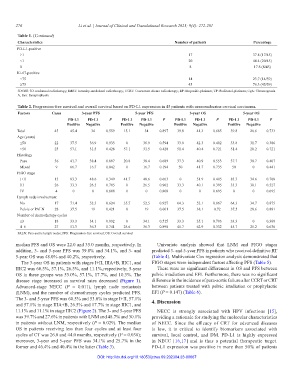
        Table 2. Progression-free survival and overall survival based on PD-L1 expression in 45 patients with neuroendocrine cervical carcinoma.
        Factors        Cases       3‑year PFS             5‑year PFS            3‑year OS              5‑year OS
                             PD‑L1    PD‑L1    P    PD‑L1   PD‑L1    P    PD‑L1   PD‑L1    P    PD‑L1    PD‑L1    P
                             Positive  Negative    Positive  Negative     Positive  Negative    Positive  Negative
        Total           45    45.4     34    0.559   15.1    34     0.897  39.8    41.3   0.685  39.8    26.6   0.733
        Age (years)
         ≤50            22    37.5    36.9   0.933    0      36.9   0.594  33.8    42.3   0.402  33.8    31.7   0.386
         >50            23    57.1    31.5   0.428   57.1    31.5   0.428  51.4    40.4   0.721  51.4    20.2   0.721
        Histology
         Pure           36    41.7    38.4   0.897   20.8    38.4   0.689  37.3    40.9   0.553  37.7    30.7   0.407
         Mixed          9     66.7    16.7   0.042    0      16.7   0.194   50     41.7   0.735   50      0     0.441
        FIGO stage
         I+II           15    83.3    48.6   0.349   41.7    48.6   0.663   0      51.9   0.405  83.3    34.6   0.708
         III            26    33.3    26.5   0.705    0      26.5   0.902  33.3    40.1   0.395  33.3    30.1   0.527
         IV             4      0       0     0.808    0       0     0.808   0       0     0.695   0       0     0.695
        Lymph node involvement
         No             17    71.4    52.5   0.624   35.7    52.5   0.927  64.3    52.1   0.867  64.3    34.7   0.875
         Pelvic or PALN  28   37.5     19    0.421    0      19     0.601  37.5    38.1   0.72   37.5    28.6   0.881
        Number of chemotherapy cycles
         ≤3             18    33.3    34.1   0.892    0      34.1   0.515  33.3    35.1   0.703  33.3     0     0.368
         4–6            27    51.3    36.3   0.741   25.6    36.3   0.890  45.7    62.9   0.332  45.7    25.2   0.636
        PALN: Para-aortic lymph nodes; PFS: Progression-free survival; OS: Overall survival

        median PFS and OS were 22.0 and 35.0 months, respectively. In   Univariate  analysis  showed  that  LNM  and  FIGO  stages
        addition, 3- and 5-year PFS was 39.8% and 34.1%, and 3- and   predicted 3- and 5-year PFS in patients who received definitive RT
        5-year OS was 48.0% and 40.2%, respectively.            (Table 4). Multivariate Cox regression analysis demonstrated that
          The 3-year OS in patients with stages I+II, IIIA+B, IIIC1, and   FIGO stages were independent factors affecting PFS (Table 5).
        IIIC2 was 60.5%, 57.1%, 26.5%, and 11.1%,respectively; 5-year   There were no significant differences in OS and PFS between
        OS in these groups was 53.0%, 57.1%, 17.7%, and 10.3%. The   pelvic irradiation and EFI. Furthermore, there was no significant
        disease  stage  increased  as  survival  rates  decreased  (Figure  1).   difference in the incidence of para-aortic failure after CCRT or CRT
        Advanced-stage  NECC  (P  =  0.011),  lymph  node  metastasis   between  patients  treated  with  pelvic  irradiation  or  prophylactic
        (LNM), and the number of chemotherapy cycles predicted PFS.   EFI (P = 0.147) (Table 6).
        The 3- and 5-year PFS was 60.5% and 53.0% in stage I+II, 57.1%   4. Discussion
        and 57.1% in stage IIIA+B, 26.5% and 17.7% in stage IIIC1, and
        11.1% and 11.1% in stage IIIC2 (Figure 2). The 3- and 5-year PFS   NECC  is  strongly  associated  with  HPV  infections  [15],
        was 39.7% and 27.6% in patients with LNM and 48.7% and 30.1%   providing a rationale for studying the molecular characteristics
        in patients without LNM, respectively (P = 0.029). The median   of  NECC.  Since  the  efficacy  of  CRT  for  advanced  diseases
        OS in patients receiving less than four cycles and at least four   is  low,  it  is  critical  to  identify  biomarkers  associated  with
        cycles of CT was 26.0 and 44.0 months, respectively (P = 0.038);   survival,  local  control,  and  DM.  PD-L1  is  highly  expressed
        moreover, 3-year and 5-year PFS was 34.1% and 25.7% in the   in NECC  [16,17]  and  is  thus  a  potential  therapeutic  target.
        former and 46.4% and 40.4% in the latter (Table 3).     PD-L1 expression was positive in more than 50% of patients
                                          DOI: http://dx.doi.org/10.18053/jctres.09.202304.23-00067

