


Page 17 - JCTR-9-5
P. 17
Ji et al. | Journal of Clinical and Translational Research 2023; 9(5): 317-321   319
        was 27.9 kg/m 6.0). The mean prebronchodilator FEV1 and FVC   4. Discussion
                   2 (
        were  2.11  L  (0.83)  and  3.15  L  (0.97),  respectively.  Thirty-one
        participants  (62%) had a prebronchodilator  FEV1/FVC < 0.70.   In our study, we observed a high level of concordance [14,15]
        Regarding pulmonary disease, 14 participants (28%) had COPD,   in the BDR after the inhalation of 400 µg of salbutamol through
                                                                                                           ®
                                                                               ®
                                                                                                   ®
        and 22 (44%) had bronchial asthma (Table 1).            both the Dosivent  and Aerochamber Plus  Flow-Vu  chambers.
          The median increases in FEV1 obtained with the Aerochamber
        Plus  Flow-Vu  and Dosivent  were 0.28 L (IQR: 0.21 – 0.38)
                    ®
                                ®
           ®
        and 0.29 L (0.20 – 0.43), respectively; these differences were
        non-significant  (Table  2). The median increases in FVC were
        0.29 L (0.19 – 0.37) and 0.28 L (188 – 453), also non-significant
        (Table 3).
          The agreement in BDR between the chambers was excellent,
        with  intraclass  correlation  coefficients  of  0.865  and  0.820,
        respectively, for FEV1 and FVC. Figures 2 and 3 show the Bland–
        Altman  graph for the increases  in FEV1 and FVC with both
        chambers. Regarding  FEV1, 3 participants  (6%) were outside
        the lower limit of agreement. For FVC, 3 participants (6%) were
        outside the limits of agreement: Two below the lower limit and
        one above the upper limit.
          Participants’  satisfaction  favored  the  Dosivent ,  with  a
                                                   ®
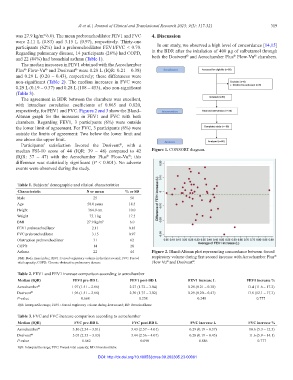
        median  FSI-10  score  of  44  (IQR:  39  –  48)  compared  to  42   Figure 1. CONSORT diagram.
        (IQR:  37  –  47)  with  the  Aerochamber  Plus   Flow-Vu ;  this
                                              ®
                                                       ®
        difference  was  statistically  significant  (P < 0.001). No adverse
        events were observed during the study.

        Table 1. Subjects’ demographic and clinical characteristics
        Characteristic               N or mean       % or SD
        Male                            25             50
        Age                           58.0 years       18.5
        Height                        164.0 cm         10.0
        Weight                        75.1 kg          17.5
        BMI                          27.9 kg/m 2       6.0
        FEV1 prebronchodilator         2.11            0.83
        FVC prebronchodilator          3.15            0.97
        Obstruction prebronchodilator   31             62
        COPD                            14             28
        Asthma                          22             44       Figure 2. Bland-Altman plot representing concordance between forced
                                                                                                                    ®
        BMI: Body mass index; FEV1: Forced expiratory volume in the first second; FVC: Forced   respiratory volume during first second increase with Aerochamber Plus
                                                                                 ®
                                                                       ®
        vital capacity; COPD: Chronic obstructive pulmonary disease  Flow Vu  and Dosivent .
        Table 2. FEV1 and FEV1 increase comparison according to aerochamber
        Median (IQR)           FEV1 pre‑BD L           FEV1 post‑BD L           FEV1 increase L         FEV1 increase %
        Aerochamber ®          1.97 (1.51 – 2.66)      2.27 (1.72 – 3.04)       0.28 (0.21 – 0.38)      13.4 (11.6 – 17.2)
        Dosivent ®             1.96 (1.51 – 2.66)      2.30 (1.75 – 3.02)       0.29 (0.20 – 0.43)      13.8 (12.1 – 17.3)
        P-value                    0.668                   0.258                   0.248                    0.777
        IQR: Interquartile range; FEV1: Forced respiratory volume during first second; BD: Bronchodilator.

        Table 3. FVC and FVC increase comparison according to aerochamber
        Median (IQR)            FVC pre‑BD L            FVC post‑BD L            FVC increase L          FVC increase %
        Aerochamber ®          3.10 (2.34 – 3.81)       3.43 (2.57 – 4.01)      0.29 (0.19 – 0.37)       10.6 (5.3 – 12.5)
        Dosivent ®             3.05 (2.35 – 3.83)       3.44 (2.56 – 4.07)      0.28 (0.19 – 0.45)       11.6 (5.9 – 14.1)
        P-value                    0.662                    0.090                   0.886                    0.777
        IQR: Interquartile range; FVC: Forced vital capacity; BD: Bronchodilator.
                                           DOI: http://dx.doi.org/10.18053/jctres.09.202305.23-00081

