


Page 22 - JCTR-9-5
P. 22
324                       Mahmood et al. | Journal of Clinical and Translational Research 2023; 9(5): 322-326
        Table 1. Patient and tumor characteristics               Table 2. Liver function parameters
        Total patients, N (%)                        55 (100)                         Baseline (range)  Post‑TARE   P
        Age at diagnosis, years                                                                       (range)
         Median                                        60        Alkaline phosphatase (U/mL) 112.0 (36.0–782.0) 198 (73–1442.0) <0.001
         Range                                        36–84      Albumin (g/dL)         4 (1.8–4.9)  3.55 (2.2–4.7)  <0.004
        Gender, N (%)                                            Bilirubin (mg/dL)     0.5 (0.2–2.3)  0.8 (0.2–5.6)  <0.001
         Male                                        21 (38.2)   ALT (U/mL)             24 (8–149)  28.5 (9–173)  <0.004
         Female                                      34 (61.8)   AST (U/mL)            28.5 (13–100)  39.5 (12–121)  <0.001
        Ethnicity, N (%)                                         Abbreviations: ALT: Alanine transaminase; AST: Aspartate transaminase
         Caucasian                                   30 (54.5)
         Hispanic                                     9 (16.4)   A
         Asian                                        9 (16.4)
         Other                                        7 (12.7)
        ECOG performance status, N (%)
         0                                           18 (32.7)
         1                                           32 (58.2)
         2                                            5 (9.1)
        Tumor sidedness, N (%)
         Left                                        40 (72.7)
         Right                                       13 (23.6)
         Unknown                                      2 (3.6)    B
        Primary tumor resected, N (%)
         Yes                                         50 (90.9)
         No                                           5 (9.1)
        TARE, N (%)
         Unilobar                                    13 (23.6)
         Bilobar                                     42 (76.4)
         Re-treatment                                 8 (14.5)
        MSI-high, N (%)
         Yes                                          2 (3.6)
         No                                          32 (58.2)
         Unknown                                     21 (38.2)
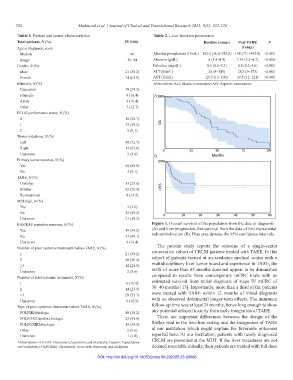
        RAS/RAF mutation presence, N (%)                        Figure 1. Overall survival of the population from the date of diagnosis
         Yes                                         19 (34.5)  (A) and liver progression-free survival from the date of first transarterial
         No                                          27 (49.1)  radioembolization (B). Blue area denotes the 95% confidence intervals.
         Unknown                                      9 (16.4)
        Number of prior systemic treatments before TARE, N (%)     The  present study reports the outcome  of a single-center
         1                                           21 (38.2)  consecutive cohort of CRLM patients treated with TARE. In this
         2                                           20 (36.4)  cohort of patients treated at an academic medical center with a
         ≥3                                          12 (21.8)  multidisciplinary liver tumor board and experience in TARE, the
         Unknown                                      2 (3.6)   mOS of more than 43 months does not appear to be diminished
        Number of total systemic treatments, N (%)              compared  to results from contemporary  mCRC trials  with an
         1                                            6 (10.9)  estimated survival from initial diagnosis of stage IV mCRC of
         2                                           14 (25.5)  30–40 months [13]. Importantly, more than a third of the patients
         ≥3                                          29 (52.7)  were  treated  with  TARE  within  12  months  of  initial  diagnosis
         Unknown                                      6 (10.9)  with no observed detrimental longer-term effects. The minimum
        Type of prior systemic treatments before TARE, N (%)    follow-up time was at least 24 months, hence long enough to show
         FOLFIRI±biologic                            10 (18.2)  any potential delayed toxicity from early integration of TARE.
         FOLFOX/CapeOx±biologic                      23 (41.8)     There  are important  differences  between  the design of the
         FOLFOXIRI±biologic                          19 (34.5)  Sirflox trial in the first-line setting and the integration of TARE
         Other                                        2 (3.6)   at  our  institution  which  might  explain  the  favorable  outcomes
         Unknown                                      1 (1.8)   reported here. At our institution, patients with newly diagnosed
        Abbreviations: FOLFOX: Fluorouracil, leucovorin, and oxaliplatin; CapeOx: Capecitabine   CRLM are presented at the MDT. If the liver metastases are not
        and oxaliplatin; FOLFOXIRI: Fluorouracil, leucovorin, irinotecan, and oxaliplatin  deemed resectable initially, then patients are treated with full dose
                                          DOI: http://dx.doi.org/10.18053/jctres.09.202305.23-00066

