


Page 26 - JCTR-9-5
P. 26
328                       Ho et al. | Journal of Clinical and Translational Research 2023; 9(5): 327-331
        need for pancreatic enzyme replacement therapy, with potentially   an ascending  colon  mass, and histology  revealed  a colonic
        improved  quality  of  life  following  cancer  survivorship  [5].   adenocarcinoma. A staging computed tomography (CT) scan of
        Despite being accepted as a valid option in patients with selected   the thorax, abdomen, and pelvis showed a 9 × 8 cm ascending
        pathologies, PSDR remains an uncommon surgical procedure.  colon mass involving the anterior abdominal  wall and right
          Although  PSDR is uncommon,  it  is one  of the  mainstream   adnexa with no distant metastases. Carcinoembryonic antigen was
        procedures for benign duodenal lesions and is widely commented   high at 160 µg/L (normal range: 0–2.5 µg/L). An open D2 right
        on.  Two  broad  classification  systems  describe  PSDR  –  one   hemicolectomy was performed (Figure 1), and the final histology
        related  to duodenal resection (total or partial)  and another   revealed pT4bN1bM0 colon adenocarcinoma with 2/27 positive
        related to the management of the ampulla of Vater (resection or   lymph nodes. All the resection margins were free of the tumor,
        preservation) [6,7]. Cantalejo-Díaz et al. performed a systematic   with the tumor invasion limited to Gerota’s fascia. Capecitabine-
        review  in  2019  and  reported  only  30  studies  with  211  patients   based adjuvant chemotherapy was started.
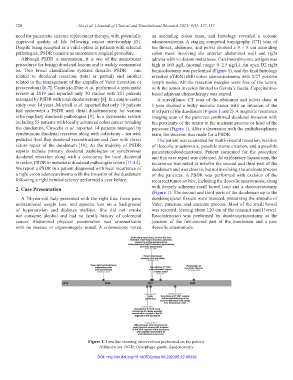
        managed by PSDR with total duodenectomy [8]. In a single-center   A surveillance  CT scan of the abdomen and pelvis done at
        study over 14 years, Mitchell et al. reported that only 19 patients   1  year  showed  a  bulky  necrotic  tumor  with  an  invasion  of  the
        had underwent a PSDR  with distal duodenectomy  for various   third part of the duodenum (Figure 1 and 2). A magnetic resonance
        infra-papillary duodenal pathologies [9]. In a systematic review   imaging scan of the pancreas confirmed duodenal invasion with
        including 53 patients with locally advanced colon cancer invading   the proximity of the tumor to the uncinate process or head of the
        the duodenum, Cirocchi et al. reported 14 patients managed by   pancreas (Figure 1). After a discussion with the multidisciplinary
        synchronous duodenal resection along with colectomy – ten with   team, the decision was made for a PSDR.
        pedicled ileal flap duodenal reconstruction and four with direct   The patient was counseled for multi-visceral resection, revision
        suture repair of the duodenum [10]. As the majority  of PSDR   of ileocolic anastomosis, possible stoma creation, and a possible
        reports include  primary duodenal  pathologies  or synchronous   pancreaticoduodenectomy. Patient consented  for the  procedure
        duodenal  resection  along  with  a colectomy  for local  duodenal   and this case report was obtained. At exploratory laparotomy, the
        invasion, PSDR in metastatic duodenal pathologies is rare [11-14].   recurrence was noted to involve the second and third part of the
        We report a PSDR in a patient diagnosed with local recurrence of   duodenum and was close to, but not involving, the uncinate process
        a right colon adenocarcinoma with the invasion of the duodenum   of the pancreas. A  PSDR was performed with excision  of the
        following a right hemicolectomy performed a year before.  recurrent tumor en bloc, including the ileocolic anastomosis, along
        2. Case Presentation                                    with densely adherent small bowel loop and a cholecystectomy
                                                                (Figure 1). The second and third parts of the duodenum up to the
          A 74-year-old lady presented with the right iliac fossa pain,   duodenojejunal flexure were resected, preserving the ampulla of
        unintentional  weight  loss,  and  appetite  loss  on  a  background   Vater, pancreas, and uncinate process. Most of the small bowel
        of  hypertension  and  diabetes  mellitus.  She  did  not  smoke   was resected, leaving about 120 cm of the remnant small bowel.
        nor consume alcohol  and had no family  history of colorectal   Reconstruction  was performed by duodenojejunostomy  at  the
        cancer.  Abdominal  physical  examination  was  unremarkable   junction  of  the  first-second  part  of  the  duodenum  and  a  new
        with no masses or organomegaly  noted.  A  colonoscopy  noted   ileocolic anastomosis.


                                      Figure 1. Timeline showing interventions performed on the patient.
                                           Abbreviation: OGD: Oesophago-gastro-duodenoscopy
                                          DOI: http://dx.doi.org/10.18053/jctres.09.202305.22-00228

