


Page 31 - JCTR-9-5
P. 31
Arab et al. | Journal of Clinical and Translational Research 2023; 9(5): 332-339   333
          Heart failure causes severe and progressive fatigue, intolerance   and reduce the risk of heart disease. A health education program
        to  exercise,  fluid  retention,  and  dyspnea,  which  often  result   developed by nurses for patients improves patients’ knowledge of
        in reduced quality of life [7]. Research in neurocardiology has   the disease and awareness of behavioral changes to prevent a new
        alluded  to  the  presence  of  a  “heart-brain”  connection  and  the   event or hospital admission [12].
        increased prevalence of anxiety, depressive, and stress symptoms   Results of previous studies showed that illness perception plays
        among this patient population [8].                      a predictive role in psychological and physical health conditions.
          Seyam et al. [2013] concluded that it is necessary to provide   Furthermore,  these  studies  suggested  that  to  understand  the
        appropriate consultation and special attention should also be paid   increase  in  adherence  to  therapy,  the  perception  of  the  disease
        to patients who have been hospitalized more often due to heart   should be increased through education to patients. Thus, health-
        disease, as well as to those who have had a long history of heart   care  providers  should  take  interventions  focused  on  changing
        disease. This ultimately prevents the recurrence of the disease and   illness  perception  to  improve  health  outcomes  in  patients  with
        is useful in improving the quality of life and health [9].  heart failure [14-16]. As far as the authors are concerned, no study
          Patient  perception  of  the  illness  affects  disease  management   has  focused  on  this  issue  in  Iran.  Therefore,  the  present  study
        and the psychological management of the patient. Being able to   was conducted to determine the effect of nursing consultation on
        diagnose the cause of the disease helps patients to guide the disease   illness perception in heart failure patients.
        control  practical  programs. The  perception  of  the  illness  is  the
        patients’ organized cognitive reflection of their illness. According   2. Methods
        to the theory of Leventhal et al., patients regulate their emotional   2.1. Study design
        behavior and response to the disease based on their perceptions of
        the nature, causes, consequences, control, and treatability of the   The present study is an experimental study in which two groups
        disease [10]. Patient support aims at increasing the perception of   of heart failure patients were assessed pre-and post-intervention.
        individual control, which is one of the important components of   2.2. Participants
        illness perception. Patient support can be a primary care strategy
        in  rebuilding  health-facilitating  programs,  reducing  fatigue,   In  this  study,  100  heart  failure  patients  were  selected  by
        and  improving  quality  of  life.  Therefore,  having  a  complete   convenient sampling method and then divided into the intervention
        understanding of the components of illness perception is useful   and control groups by block randomization method. In the block
        and effective for guiding a person to a good quality of life [11].  randomization method, the number of patients assigned to each
          Lucas et al. (2015) examined the effect of nurse consultation   group is almost equal. In this method, blocks were formed based
        on  heart  disease,  the  beliefs,  and  the  quality  of  life  of  heart   on the variables considered in the present study. One-half of each
        failure  patients.  They  found  that  being  in  touch  with  a  nurse   block comprised intervention subjects and the other half includes
        who specializes in heart failure patients, could improve patients’   the control group participants. The main goal of this method is to
        satisfaction with treatment decisions. However, it had less effect   give a balance to the number of participants in each group.
        on a patient’s beliefs compared to personal control and treatment   The sample size was determined based on previous studies [17]
        control [4].                                            and using the comparison formula of two averages and considering
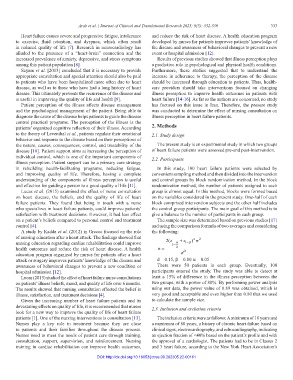
          A study by Kadda et al. (2012) in Greece focused on the role   the following:
        of nursing education after a heart attack. The findings showed that       z  2
        nursing education regarding cardiac rehabilitation could improve   2(z 1− α  + z 1 β  −  ) σ
        health  outcomes  and  reduce  the  risk  of  heart  disease. A  health   n  =  2  2
        education program organized by nurses for patients after a heart     d
        attack or surgery improves patients’ knowledge of the disease and   d = 0.15, β = 0.80 α = 0.05
        awareness of behavioral changes to prevent a new condition or   There  were  50  patients  in  each  group.  Eventually,  100
        hospital admission [12].                                participants  entered  the  study.  The  study  was  able  to  detect  at
          Lucas (2015) studied the effect of heart failure nurse consultations   least a 15% of difference in the illness perception between the
        on patients’ illness beliefs, mood, and quality of life over 6 months.   two groups, with a power of 80%. By performing power analysis
        The results showed that nursing consultation affected the belief in   using our data, the power value of 0.89 was obtained, which is
        illness, satisfaction, and treatment decisions [4].     very good and acceptable and even higher than 0.80 that we used
          Given the increasing number of heart failure patients and its   to calculate the sample size.
        devastating effects on quality of life, it is recommended that nurses   2.3. Inclusion and exclusion criteria
        look for a new way to improve the quality of life of heart failure
        patients [1]. One of the nursing interventions is consultation [13].   The inclusion criteria were as follows: A minimum of 18 years and
        Nurses  play  a  key  role  in  treatment  because  they  are  close   a maximum of 80 years, a history of chronic heart failure based on
        to  patients  and  their  families  throughout  the  disease  process.   clinical signs, electrocardiography, and echocardiography, indicating
        Nurses need to meet the needs of patient care through training,   an ejection fraction of <40% based on the patient’s profile and with
        consultation,  support,  supervision,  and  reinforcement.  Nursing   the approval of a cardiologist. The patients had to be in Classes 2
        training  in  cardiac  rehabilitation  can  improve  health  outcomes,   and 3 heart failure, according to the New York Heart Association’s
                                          DOI: http://dx.doi.org/10.18053/jctres.09.202305.22-00161

