


Page 34 - JCTR-9-5
P. 34
336                       Arab et al. | Journal of Clinical and Translational Research 2023; 9(5): 332-339
        Table 1. (Continued)
        Variable                           Control group               Intervention group       Chi‑square       P
                                    Frequency      Percentage     Frequency      Percentage
        Duration of heart disease
         <1 year                        7            15.6            11            24.4           5.561        0.135
         Between one and three years   11            24.4            10            22.2
         3–5 years                     17            37.8            8             17.8
         More than 5 years             10            22.2            16            35.6
        Hospitalization history
         1–2                            9            20.0            12            26.7           5.821        0.121
         3–4                           12             26.7           14            31.1
         5–6                           17            42.2            9             20.0
         7 and more                     5            11.1            10            22.2
        Tobacco use
         No                            18            40.0            27            60.0           5.227        0.265
         Opium                         10            22.2            6             13.3
         Cigar                          5            11.1            4             8.9
         Meth                           0             0.0            1             2.2
         Opium and cigar               12            26.7            7             15.6
        Ejection fraction percentage
         10–20%                         8            17.8            11            24.4           1.068        0.586
         20–30%                        21            46.7            22            48.9
         30–40%                        16            35.6            12            26.7
        Heart failure Class
         Class 2                       16            35.6            15            33.3           0.049        0.824
         Class 3                       29            46.4            30            66.7


        2.7. Ethical considerations                              Table  2.  Comparing  mean  score  for  illness  perception  before
                                                                 intervention between two groups
          This study was approved by the Ethics Committee of Kerman   Group       Mean±SD        Statistic    P‑value
        University  of  Medical  Sciences  (IR.KMU.REC.1397.431,  29-1-                            1.73        0.087
                                                                                 4.98±28.22
        2019). The purpose of the research was explained to the samples. The   Control  10.94±31.33
                                                                 Intervention
        participants were not obliged to participate in the study. The letter
        of recommendation was obtained from the Faculty of Nursing and
        presented to the research environment authorities before collecting   Table 3. Comparing mean score for illness perception after intervention
        the data. Written consent was obtained from the study participants   between two groups using analysis of covariance
        before they took part in the study. The consultation was given to the   Group  Mean±SD  Mean difference (95%   Statistic  P‑value
        control group patients after completing the study upon their demand.          confidence interval)
                                                                 Control   7.65±27.47  5.53 (1.69, 9.36)  8.23  0.005
        3. Results                                               Intervention  10.25±33.49

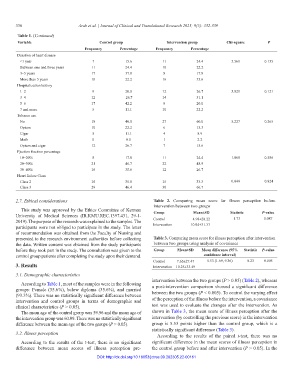
        3.1. Demographic characteristics
                                                                intervention between the two groups (P > 0.05) (Table 2), whereas
          According to Table 1, most of the samples were in the following   a  post-intervention  comparison  showed  a  significant  difference
        groups:  Female  (55.6%),  below  diploma  (35.6%),  and  married   between the two groups (P < 0.005). To control the varying effect
        (93.3%). There was no statistically significant difference between
        intervention  and  control  groups  in  terms  of  demographic  and   of the perception of the illness before the intervention, a covariance
        clinical characteristics (P > 0.05).                    test was used to evaluate the changes after the intervention. As
          The mean age of the control group was 59.96 and the mean age of   shown in Table 3, the mean score of illness perception after the
        the intervention group was 60.09. There was no statistically significant   intervention (by controlling the previous score) in the intervention
        difference between the mean age of the two groups (P > 0.05).  group  is  5.53  points  higher  than  the  control  group,  which  is  a
                                                                statistically significant difference (Table 3).
        3.2. Illness perception                                    According  to  the  results  of  the  paired  t-test,  there  was  no
          According  to  the  results  of  the  t-test,  there  is  no  significant   significant difference in the mean scores of illness perception in
        difference  between  mean  scores  of  illness  perception  pre-  the control group before and after intervention (P > 0.05). In the
                                          DOI: http://dx.doi.org/10.18053/jctres.09.202305.22-00161

