


Page 27 - JCTR-9-5
P. 27
Ho et al. | Journal of Clinical and Translational Research 2023; 9(5): 327-331   329
                                                                distal duodenum) [6]. In our patient,  pancreas-sparing distal
                                                                duodenectomy was performed with transection at the level of the
                                                                ampulla of Vater. With regards to the management of the ampulla of
                                                                Vater, three types of technical modifications are described [7,17].
                                                                Type  I includes  the  preservation  of the  pancreas’s major  and
                                                                minor papilla  and the upper or lower portion  of the  duodenal
                                                                wall. Type II only preserves the major papilla anastomosed to the
                                                                jejunum. Type III is an excision of the intraduodenal segment of
                                                                the major papilla to expose the distal segments of the bile duct
                                                                and pancreatic ducts before anastomosing them to the jejunum.
                                                                In our patient, the Type I technique was sufficient for achieving
                                                                oncological clearance [7,17].
                                                                   PSDR saves the need for pancreaticoduodenectomies with a
                                                                reduction  in  the  risk  of  POPF.  Preserving  the  pancreas  allows
                                                                for shorter surgical  time,  less intraoperative  bleeding,  and the
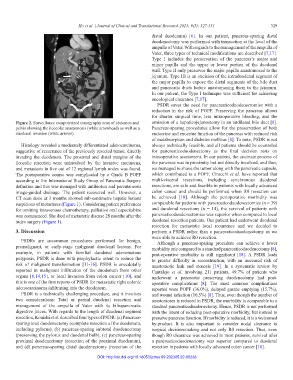
        Figure 2. Surveillance computerized tomography scan of abdomen and   omission of a hepaticojejunostomy in an undilated bile duct [8].
        pelvis showing the ileocolic anastomosis (white arrowhead) as well as a   Pancreas-sparing  procedures allow for the  preservation  of both
        duodenal invasion (white arrows).                       endocrine and exocrine function of the pancreas with reduced risk
                                                                of malabsorption and diabetes mellitus [8]. To note, PSDR is not
          Histology revealed a moderately differentiated adenocarcinoma,   always technically feasible, and all patients should be counseled
        suggestive of recurrence of the previously resected tumor, directly   for  pancreaticoduodenectomy  as  the  final  decision  rests  on
        invading the duodenum. The proximal and distal margins of the   intraoperative assessment. In our patient, the uncinate process of
        ileocolic resection were uninvolved by the invasive carcinoma,   the pancreas was in proximity but not directly involved, and thus,
        and metastasis in five out of 12 regional lymph nodes was found.   we managed to shave the tumor along with the pancreatic capsule,
        The  postoperative  course  was  complicated  by  a  Grade  B  POPF   which contributed to a POPF. Cirocchi et al. have reported that
        according to the International Study Group of Pancreatic Surgery   multi-visceral  resections,  including  synchronous duodenal
        definition and this was managed with antibiotics and percutaneous   resections, are safe and feasible in patients with locally advanced
        image-guided  drainage.  The  patient  recovered  well.  However,  a   colon  cancer  and  should be  performed  when  R0  resection  can
        CT scan done at 3 months showed sub-centimetre hepatic lesions   be achieved [10].  Although the perioperative  morbidity  was
        suspicious of metastases (Figure 1). Considering patient preferences   comparable for patients with pancreaticoduodenectomies (n = 39)
        for omitting intravenous chemotherapy, palliative oral capecitabine   and duodenal resections (n = 14), the survival of patients with
        was commenced. She died of metastatic disease 28 months after the   pancreaticoduodenectomies was superior when compared to local
        index surgery (Figure 1).                               duodenal resection patients. Our patient had underwent duodenal
                                                                resection  for metastatic  local  recurrence  and we decided  to
        3. Discussion                                           perform a PSDR rather than a pancreaticoduodenectomy as we
                                                                were able to achieve R0 resection.
          PSDRs are  uncommon  procedures performed  for benign,   Although a pancreas-sparing procedure can achieve a lower
        premalignant,  or  early-stage  malignant  duodenal  lesions.  For   morbidity rate compared to a standard pancreaticoduodenectomy [8],
        example,  in  patients  with  familial  duodenal  adenomatous   post-operative  morbidity  is  still  significant  [18].  A  PSDR leads
        polyposis, PSDR is done with prophylactic intent to reduce the   to  greater  difficulty  in  reconstruction,  with  an  increased  risk  of
        risk  of  malignant  transformation  [11-16]. PSDR  is anecdotally   anastomotic  leak  and  stenosis  [19]. In a systematic review by
        reported  in  malignant  infiltration  of  the  duodenum  from  other   Cantalejo et al.  involving  211  patients,  49.7%  of  patients  who
        organs [6,14,15], or local invasion from colon cancer [10], and   underwent  a  pancreatic  preserving  duodenectomy  had  post-
        this is one of the first reports of PSDR for metastatic right colonic   operative complications [8].  The most common complications
        adenocarcinoma infiltrating into the duodenum.          reported were POPF (36.0%), delayed gastric emptying (15.7%),
          PSDR is a technically challenging procedure, and it involves   and wound infection (10.5%) [8]. Thus, even though the number of
        two considerations:  Total or partial  duodenal resection and   anastomoses is reduced in PSDR, the morbidity is comparable to a
        management  of the ampulla  of  Vater with its biliopancreatic   standard pancreaticoduodenectomy. Hence, PSDR is not performed
        digestive juices. With regards to the length of duodenal segment   with the intent of reducing post-operative morbidity, but instead to
        resection, Konishi et al. described four types of PSDR: (a) Pancreas-  preserve pancreas function. If morbidity is reduced, it is a welcomed
        sparing total duodenectomy (complete resection of the duodenum,   by-product. It is also important to consider nodal clearance in
        including pylorus), (b) pancreas-sparing subtotal duodenectomy   surgical  decision-making  and  not  only  R0  resection.  Thus,  even
        (preserving the pylorus and duodenal bulb), (c) pancreas-sparing   though R0 clearance was achieved in most patients, survival after
        proximal duodenectomy (resection of the proximal duodenum),   a  pancreaticoduodenectomy  was superior compared  to duodenal
        and (d) pancreas-sparing distal duodenectomy (resection of the   resection in patients with locally advanced colon cancer [10].
                                          DOI: http://dx.doi.org/10.18053/jctres.09.202305.22-00228

