


Page 15 - MI-1-1
P. 15
Microbes & Immunity                                      RANTES/CCL5 and ezrin peptide RepG3 for long COVID


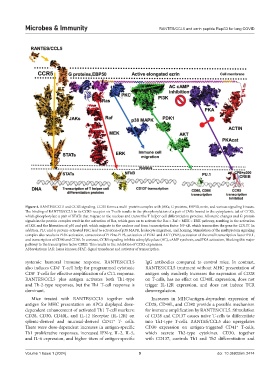
            Figure 4. RANTES/CCL5 and CCR5 signaling. CCR5 forms a multi-protein complex with JAKs, G proteins, EBP50, ezrin, and various signaling kinases.
            The binding of RANTES/CCL5 to its CCR5 receptor on T-cells results in the phosphorylation of a pair of JAKs bound to the cytoplasmic tail of CCR5,
            which phosphorylate a pair of STATs that migrate to the nucleus and transcribe T helper cell differentiation proteins. Allosteric changes and G protein
            signals in the protein complex result in the activation of Ras, which goes on to activate the Ras > Raf > MEK > ERK pathway, resulting in the activation
            of IKK and the liberation of p50 and p65, which migrate to the nucleus and form transcription factor NF-κB, which transcribes the gene for CD137. In
            addition, PLC and G protein-activated PKC lead to activation of p38 MAPK, leukocyte migration, and homing. Stimulation of the multiprotein signaling
            complex also results in PI3K activation, conversion of PIP2 to PIP3, activation of PDK1 and AKT (PKB), activation of the small transcription factor PU.1,
            and transcription of CD80 and CD86. In contrast, CCR5 signaling inhibits adenylyl cyclase (AC), cAMP synthesis, and PKA activation, blocking this major
            pathway to the transcription factor CREB. This results in the inhibition of CCR5 expression.
            Abbreviations: JAK: Janus kinases; STAT: Signal transducer and activator of transcription.

            systemic humoral immune response. RANTES/CCL5      IgG antibodies compared to control mice. In contrast,
            also induces CD4  T-cell help for programmed cytotoxic   RANTES/CCL5 treatment without MHC presentation of
                          +
                +
            CD8  T-cells for effective amplification of a CTL response.   antigen only modestly increases the expression of CD28
            RANTES/CCL5 plus antigen activates both Th1-type   on T-cells, has no effect on CD40L expression, does not
            and Th-2-type responses, but the Th1 T-cell response is   trigger IL-12R expression, and does not induce TCR
            dominant.                                          downregulation.
              Mice treated with RANTES/CCL5 together with        Increases in MHC/antigen-dependent expression of
            antigen for MHC presentation on APCs displayed dose-  CD28, CD40L, and CD80 provide a possible mechanism
            dependent enhancement of activated Th1 T-cell markers:   for immune amplification by RANTES/CCL5. Stimulation
            CD28,  CD30,  CD40L,  and  IL-12  Receptor  (IL-12R)  on   of CD28 and CD137 causes naive T-cells to differentiate
                                                 +
            splenic-derived and mucosal-derived CD41  T-  cells.   into Th1-type  T-cells. RANTES/CCL5 also upregulates
            There  were  dose-dependent  increases  in  antigen-specific   CD30 expression on antigen-triggered CD41  T-cells,
                                                                                                      +
            Th1 proliferative responses, increased IFN-γ, IL-2, IL-5,   which secrete Th2-type cytokines. CD30, together
            and IL-6 expression, and higher titers of antigen-specific   with  CD137,  controls  Th1  and  Th2  differentiation  and

            Volume 1 Issue 1 (2024)                         9                                doi: 10.36922/mi.2474

