


Page 109 - MI-1-2
P. 109
Microbes & Immunity                                             Cedecea lapagei in a case of pleural empyema


            Daltonik GmbH, Bremen, Germany) and Vitek™ 2 GN    Cedecea superinfection in a 50-year-old Indian man with
            system (bioMerieux, Marcy l’Etoile, France), MicroScan   a malignant oral ulcer with squamous cell carcinoma of
            WalkAway 96 plus System (Beckman Coulter, USA), and   the right buccal mucosa. In addition, Islam et al.,  Ahmed
                                                                                                      10
            VersaTREK blood and body fluid culture system (TREK   et al.  and Ramaswamy  et al.  have reported neonatal
                                                                   11
                                                                                        13
            diagnostic, Cleveland, Ohio). 4                    cases of Cedecea infection from India.
              Cedecea was first recognized as a human pathogen in   Cedecea  is  intrinsically  resistant  to  colistin
            2006 by Davis  et al.  who reported the first case of  the   (polymyxin  E). Data on the Cedecea resistance to drugs
                             1
            microorganism in a patient having peritonitis related to   remains limited in the literature. It is important to note that,
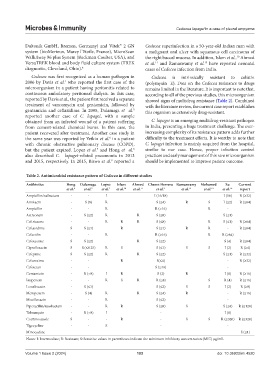
            continuous ambulatory peritoneal dialysis. In this case,   according to all of the previous studies, this microorganism
            reported by Davis et al., the patient first received a separate   showed signs of multidrug resistance (Table 2). Combined
            treatment of vancomycin and gentamicin, followed by   with the literature review, the current case report establishes
            gentamicin and ceftazidime. In 2008, Dalamaga et   al.    this organism as extensively drug-resistant.
                                                          5
            reported another case of  C.  lapagei, with a sample
            obtained from an infected wound of a patient suffering   C. lapagei is an emerging multidrug-resistant pathogen
            from  cement-related  chemical  burns.  In  this  case,  the   in India, presenting a huge treatment challenge. The ever-
            patient recovered after treatment. Another case study in   increasing complexity of its resistance pattern adds further
            the same year was reported by Yetkin et al.  in a patient   difficulty to the treatment efforts. It is worthy to note that
                                                6
            with  chronic  obstructive  pulmonary  disease  (COPD),   C. lapagei infection is mainly acquired from the hospital,
            but the patient expired. Lopez  et al.  and Hong  et   al.    similar to our case. Hence, proper infection control
                                                          8
                                          7
            also described  C.   lapagei-related pneumonia in 2013   practices and early management of this rare microorganism
            and 2015, respectively. In 2015, Biswa et al.  reported a   should be implemented to improve patient outcome.
                                                9
            Table 2. Antimicrobial resistance pattern of Cedecea in different studies
            Antibiotics      Hong   Dalamaga   Lopez    Islam    Ahmed   Chavez Herrera  Ramaswamy  Mohamed   Xu    Current
                             et al. 8  et al. 5  et al. 7  et al. 10  et al. 11  et al. 2  et al. 13  et al. 12  et al. 16  report
            Ampicillin/sulbactam  -   -       I                    I (16/18)                    I (16)  R (≥32)
            Amikacin           -     S (8)    R                     S (≤4)      R         S     I (≤2)  R (≥64)
            Ampicillin         -      -       R                    R (>16)               R        -
            Aztreonam          -     S (≤2)   R            R        S (≤8)                      S (≤1)
            Ceftriaxone        -      -       R     R      R        S (≤8)               R      S (≤1)  R (≥64)
            Ceftazidime        S     S (≤1)         R               S (≤1)      R        R        -    R (≥64)
            Cefazolin          -      -       R                    R (≥16)               R     R (≥64)
            Cefotaxime         S     S (≤2)                R        S (≤2)                      S (4)  R (≥64)
            Ciprofloxacin      S    S (≤0.25)  R    S               S (≤1)      S         S      I (2)  R (≥4)
            Cefepime           S     S (≤2)   R            R        S (≤2)                      S (≤1)  R (≥32)
            Cefuroxime         -      -             R               S(≤4)                         -    R (≥32)
            Cefotetan          -      -                            S (≤16)                        -
            Gentamicin         -     R (>8)   I     R               S (2)       R                I (8)  R (≥16)
            Imipenem           -      -       R     S      R       R (≥8)                 S     R (4)  R (≥16)
            Levofloxacin       -     S (≤1)                         S (≤2)      S         S      I (2)  R (≥8)
            Meropenem          -     S (4)    R            R        S (≤4)      R                 -    R (≥16)
            Moxifloxacin       -      -       R                     S (≤2)                        -
            Piperacillin/tazobactam  -  -     R     R               S (≤8)      S               S (≤4)  R (≥128)
            Tobramycin         -     R (>8)   I                      -                           I (8)
            Cotrimoxazole      S      -       -     R                -          S         S    R (≥320)  R (≥320)
            Tigecycline        -      -       S                      -                            -
            Minocycline                                                                                S (≤1)
            Notes: I: Intermediate; R: Resistant; S: Sensitive values in parentheses indicate the minimum inhibitory concentration (MIC) µg/mL.


            Volume 1 Issue 2 (2024)                        103                               doi: 10.36922/mi.4520

