


Page 92 - MI-1-2
P. 92
Microbes & Immunity                                     Identifying hydrogenase orthologs in the human proteome


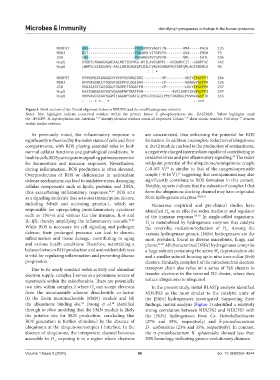
            Figure 4. Short sections of the Clustal alignment between NDUFS7 and the small hydrogenase subunits
            Notes: Blue highlights indicate conserved residues within the protein kinase C phosphorylation site  -RASPRQS-. Yellow highlights mark
            the -IPGCPP- N-myristoylation site. Asterisks “*” identify identical residues across all sequences. Colons “:” show similar residues. Full stops “.” denotes
            weakly similar residues.

              As previously noted, the inflammatory response is   are concentrated, thus enhancing the potential for ROS
            significantly influenced by the redox status of cells and their   formation. In addition, incomplete reduction of ubiquinone
            compartments, with ROS playing essential roles in both   at the Q module can lead to the production of semiquinone,
            normal cellular functions and pathological conditions. In   a negatively charged intermediate capable of contributing to
            healthy cells, ROS participate in signaling pathways essential   oxidative stress and proinflammatory signaling.  The redox
                                                                                                    55
            for  homeostasis  and  immune  responses.  Nevertheless,   midpoint potential of the ubiquinone/semiquinone couple
            during inflammation, ROS production is often elevated.   (−0.163 V)  is similar to that of the oxygen/superoxide
                                                                        56
                                                                             57
            Overproduction of ROS or deficiencies in antioxidant   couple (−0.16 V),  suggesting that semiquinones may also
            defense mechanisms can lead to oxidative stress, damaging   significantly contribute to ROS formation in this context.
            cellular components such as lipids, proteins, and DNA,   Notably, reports indicate that the subunits of complex I that
            thus exacerbating inflammatory responses. 49,50  ROS acts   form the ubiquinone docking channel may have originated
            as a signaling molecule that activates transcription factors,   from hydrogenase enzymes. 28,29,31
            including  NFκB and  activating  protein-1, which are   Numerous empirical and pre-clinical studies have
            responsible for upregulating proinflammatory cytokines   identified H  as an effective redox mediator and regulator
                                                                         2
            such as TNF-α and various ILs (for instance, IL-6 and   of the immune response. 58-64  In single-celled organisms,
            IL-1β), thereby amplifying the inflammatory cascade. 51,52    H is metabolized by hydrogenase enzymes that catalyze
                                                                2
            While ROS is necessary for cell signaling and pathogen   the reversible oxidation/reduction of H . Among the
                                                                                                 2
            defense, their prolonged presence can lead to chronic   various hydrogenase groups, [NiFe] hydrogenases are the
            inflammation and tissue damage, contributing to aging   most prevalent, found in diverse microbiota, fungi, and
            and various health conditions. Therefore, maintaining a   plants. 65-67  All characterized [NiFe] hydrogenases comprise
            balance between ROS production and antioxidant defenses   a large subunit containing the active H  deprotonation site
                                                                                              2
            is vital for regulating inflammation and preventing disease   and a smaller subunit housing up to nine iron-sulfur (FeS)
            progression.                                       clusters. Similarly, complex I of the mitochondrial electron
              Due to its nearly constant redox activity and abundant   transport chain also relies on a series of FeS clusters to
            electron supply, complex I serves as a prominent source of   transfer electrons to the terminal N2 cluster, where they
            superoxide within the mitochondria. There are potentially   reduce ubiquinone to ubiquinol.
            two sites within complex I where O  can accept electrons   In the present study, initial BLASTp analysis identified
                                         2
            from the nicotinamide adenine dinucleotide co-factor:   NDUFS2 as the most similar to the catalytic units of
            (i) the flavin mononucleotide (FMN) module and (ii)   the [NiFe] hydrogenases investigated. Supporting these
            the ubiquinone binding site.  Duong  et al.  identified   findings, matrix analysis (Figure 1) identified a relatively
                                                 54
                                    53
            through in silico modeling that the FMN module is likely   strong correlation between NDUFS2 and NDUFS7 with
            the  putative  site  for  ROS  production,  concluding  that   the  [NiFe]  hydrogenases  from  Ca.  Heimdallarchaeota
            ROS generation is further stimulated by the absence of   (27% and 35%, respectively) and  δ-proteobacterium
            ubiquinone at the ubiquinone/complex I interface. In the   D.  carbinolicus (23% and 35%, respectively). In contrast,
            absence of ubiquinone, the intraprotein channel becomes   the  α-proteobacterium  R. sphaeroides  showed less than
            accessible to O , exposing it to a region where electrons   20% homology, indicating greater evolutionary distance.
                        2

            Volume 1 Issue 2 (2024)                         86                               doi: 10.36922/mi.4544

