


Page 47 - MI-2-2
P. 47
Microbes & Immunity                                                                Probiotics & obesity


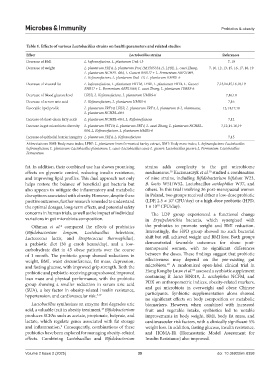
            Table 1. Effects of various Lactobacillus strains on health parameters and related studies
            Effect                                      Lactobacillus strains                   References
            Decrease of BMI          L. kefiranofaciens, L. plantarum Dad-13                      7, 10
            Decrease of weight       L. plantarum FRT4, L. plantarum Pro1 (MT505334.1), LFBE, L. casei Zhang,    7, 10, 12, 13, 15, 16, 17, 18, 19
                                     L. plantarum NCHBL–004, L. Gasseri BNR17 + L. Fermentum ABF21069,
                                     L. Kefiranofaciens, L. plantarum Dad–13, L. plantarum HMRS–6
            Decrease of visceral fat  L. kefiranofaciens, L. plantarum FRT10, LFBE, L. plantarum FRT4, L. Gasseri   7,13,14,15,16,18,19
                                     BNR17 + L. Fermentum ABF21069, L. casei Zhang, L. plantarum HMRS‑6
            Decrease of blood glucose level  LFBE, L. Kefiranofaciens, L. plantarum HMRS‑6       7,16,18
            Decrease of serum uric acid  L. Kefiranofaciens, L. plantarum HMRS‑6                  7,16
            Favorable lipid profile  L. plantarum FRT10, LFBE, L. plantarum FRT4, L. plantarum & L. rhamnosus,    12,14,17,18
                                     L. plantarum NCHBL–004
            Increase of short-chain fatty acids  L. plantarum NCHBL–004, L. Kefiranofaciens       7,12
            Increase in gut microbiota diversity  L. plantarum FRT10, L. plantarum FRT4, L. casei Zhang, L. plantarum NCHBL–  7,12,14-16,19
                                     004, L. Kefiranofaciens, L. plantarum HMRS‑6
            Increase of epithelial barrier integrity L. plantarum FRT4, L. Kefiranofaciens        7,15
            Abbreviations: BMI: Body mass index; LFBE: L. plantarum from fermented barley extract, BMI: Body mass index; L. kefiranofaciens: Lactobacillus
            kefiranofaciens; L. plantarum: Lactobacillus plantarum; L. casei: Lactobacillus casei; L. gasseri: Lactobacillus gasseri; L. Fermentum: Lactobacillus
            Fermentum.


            fat. In addition, their combined use has shown promising   strains adds complexity to the gut microbiome
            effects on glycemic control, reducing insulin resistance,   mechanisms.  Kaczmarczyk et al.  studied a combination
                                                                         20
                                                                                          20
            and improving lipid profiles. This dual approach not only   of nine strains, including  Bifidobacterium bifidum W23,
            helps  restore  the balance  of beneficial  gut  bacteria  but   B. lactis W51/W52, Lactobacillus acidophilus W37, and
            also appears to mitigate the inflammatory and metabolic   others. In this trial involving 36 post-menopausal women
            disruptions associated with obesity. However, despite these   in Poland, two groups received either a low-dose probiotic
            positive outcomes, further research is needed to understand   (LDP, 2.5 × 10  CFU/day) or a high-dose probiotic (HPD,
                                                                          9
                                                                    10
            the optimal dosages, long-term effects, and potential safety   1 × 10  CFU/day).
            concerns in human trials, as well as the impact of individual   The LDP group experienced a functional change
            variations in gut microbiota composition.          in  Erysipelotrichia bacteria, which synergized with
              Othman  et al.  compared the effects of probiotics   the probiotics to promote weight and BMI reduction.
                           4
            (Bifidobacterium  longum,   Lactobacillus  helveticus,   Interestingly,  the  HPD  group  showed  no  such  bacterial
            Lactococcus lactis,  and  Streptococcus thermophilus),   shift but still achieved weight and BMI loss. Both groups
            a prebiotic diet (30  g carob beans/day), and a low-  demonstrated favorable outcomes for obese post-
            carbohydrate diet in 45 obese patients over the course   menopausal women, with no significant differences
            of  1  month. The  probiotic  group  showed  reductions  in   between the doses. These findings suggest that probiotic
            weight, BMI,  waist circumference,  fat  mass, depression,   effectiveness may depend on the pre-existing gut
                                                                        20
            and fasting glucose, with improved grip strength. Both the   microbiota.   A  randomized  open-label  clinical  trial  in
                                                                                   21
            probiotic and prebiotic-receiving groups showed improved   Hong Kong by Lauw et al.  assessed a synbiotic supplement
            lean  mass  and  physical  performance,  with  the  probiotic   containing  B. lactis HN019,  L. acidophilus  NCFM, and
            group showing a smaller reduction in serum uric acid   PDX on anthropometric indices, obesity-related markers,
            (SUA), a key factor in obesity-related insulin resistance,   and gut microbiota in overweight and obese Chinese
            hypertension, and cardiovascular risk. 4,19        participants. Synbiotic supplementation alone showed
                                                               no significant effects on body composition or metabolic
              Lactobacillus synthesizes an enzyme that degrades uric   biomarkers.  However,  when  combined  with  increased
            acid, a valuable trait in obesity treatment.  Bifidobacterium   fruit and vegetable intake, synbiotics  led to notable
                                            19
            produces SCFAs such as acetate, propionate, butyrate, and   improvements in body weight, BMI, body fat mass, and
            lactate, which regulate genes associated with fat storage   cardiovascular risk factors, with a clinically significant 5%
            and inflammation.  Consequently, combinations of these   weight loss. In addition, fasting glucose, insulin resistance,
                           9
            probiotics have been explored for managing obesity-related   and  HOMA-IR  (Homeostatic  Model  Assessment  for
            effects. Combining  Lactobacillus and  Bifidobacterium   Insulin Resistance) also improved.


            Volume 2 Issue 2 (2025)                         39                               doi: 10.36922/mi.8358

