


Page 101 - MI-2-3
P. 101
Microbes & Immunity                                                SARS-CoV-2 complementary classification


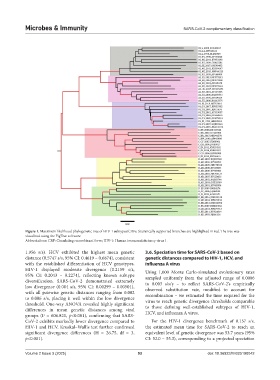
            Figure 1. Maximum likelihood phylogenetic tree of HIV-1 subtypes/CRFs. Statistically supported branches are highlighted in red. The tree was
            visualized using the FigTree software.
            Abbreviations: CRF: Circulating recombinant form; HIV-1: Human immunodeficiency virus 1.

            1.956  s/s). HCV exhibited the highest mean genetic   3.6. Speciation time for SARS-CoV-2 based on
            distance (0.5747 s/s, 95% CI: 0.4619 – 0.6874), consistent   genetic distances compared to HIV-1, HCV, and
            with the established differentiation of HCV genotypes.   influenza A virus
            HIV-1  displayed  moderate  divergence  (0.2159  s/s,   Using 1,000 Monte Carlo-simulated evolutionary rates
            95% CI: 0.2043 – 0.2274), reflecting known subtype   sampled uniformly from the adjusted range of 0.0006
            diversification. SARS-CoV-2 demonstrated extremely   to 0.003  s/s/y – to reflect SARS-CoV-2’s empirically
            low divergence (0.004 s/s, 95% CI: 0.00299 – 0.00501),   observed substitution rate, modified to account for
            with all pairwise genetic distances ranging from 0.002   recombination – we estimated the time required for the
            to 0.006  s/s, placing it well within the low divergence   virus to reach genetic divergence thresholds comparable
            threshold. One-way ANOVA revealed highly significant
            differences in mean genetic distances among viral   to those defining well-established subtypes of HIV-1,
                                                               HCV, and influenza A virus.
            groups (F = 606.821,  p<0.001), confirming that SARS-
            CoV-2 exhibits markedly lower divergence compared to   For the HIV-1 divergence benchmark of 0.157  s/s,
            HIV-1 and HCV. Kruskal–Wallis test further confirmed   the  estimated mean  time for  SARS-CoV-2  to  reach  an
            significant divergence differences (H = 26.75, df = 3,   equivalent level of genetic divergence was 53.7 years (95%
            p<0.001).                                          CI: 52.0 – 55.3), corresponding to a projected speciation


            Volume 2 Issue 3 (2025)                         93                           doi: 10.36922/MI025190042

