


Page 119 - MI-2-3
P. 119
Microbes & Immunity                                                  Statistical modeling of COVID-19 trends


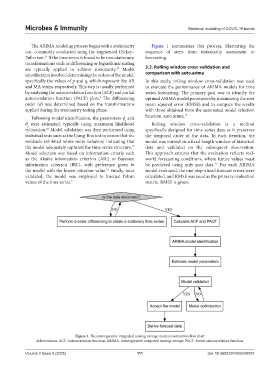
              The ARIMA modeling process began with a stationarity   Figure  1 summarizes this process, illustrating the
            test, commonly conducted using the augmented Dickey–  sequence of steps from stationarity assessment to
                    11
            Fuller test.  If the time series is found to be non-stationary,   forecasting.
            transformations such as differencing or logarithmic scaling
            are typically  applied to achieve stationarity.  Model   3.2. Rolling window cross-validation and
                                                   10
            identification involved determining the orders of the model,   comparison with auto.arima
            specifically the values of p and q, which represent the AR   In this study, rolling window cross-validation was used
            and MA terms, respectively. This step is usually performed   to evaluate the performance of ARIMA models for time
            by analyzing the autocorrelation function (ACF) and partial   series forecasting. The primary goal was to identify the
            autocorrelation function (PACF) plots.  The differencing   optimal ARIMA model parameters by minimizing the root
                                            9
            order (d)  was determined based on the transformations   mean squared error (RMSE) and to compare the results
            applied during the stationarity testing phase.     with those obtained from the automated model selection
              Following model identification, the parameters ϕ  and   function, auto.arima. 14
                                                      i
            θ   were estimated, typically using maximum likelihood   Rolling window cross-validation is a method
             j
            estimation.  Model validation was then performed using   specifically designed for time series data as it preserves
                     10
            statistical tests such as the Ljung-Box test to ensure that the   the temporal order of the data. In each iteration, the
            residuals exhibited white noise behavior, indicating that   model was trained on a fixed-length window of historical
            the model adequately captured the time series structure.    data and validated on the subsequent observation.
                                                         12
            Model  selection  was  based  on  information  criteria  such   This approach ensures that the evaluation reflects real-
            as the Akaike information criterion (AIC) or Bayesian   world forecasting conditions, where future values must
            information criterion (BIC), with preference given to   be predicted using only past data.  For each ARIMA
                                                                                            15
                                              13
            the model with the lowest criterion value.  Finally, once   model evaluated, the one-step-ahead forecast errors were
            validated, the model was employed to forecast future   calculated, and RMSE was used as the primary evaluation
            values of the time series. 9                       metric. RMSE is given:


                                 Figure 1. The autoregressive integrated moving average model construction flow chart
                Abbreviations: ACF: Autocorrelation function; ARIMA: Autoregressive integrated moving average; PACF: Partial autocorrelation function.

            Volume 2 Issue 3 (2025)                        111                           doi: 10.36922/MI025040007

