


Page 123 - MI-2-3
P. 123
Microbes & Immunity                                                  Statistical modeling of COVID-19 trends


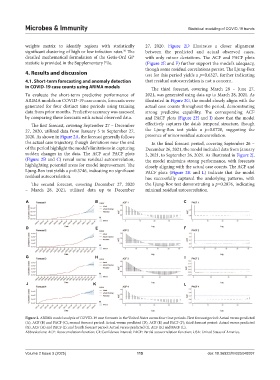
            weights matrix to identify regions with statistically   27, 2020.  Figure  2D illustrates a closer alignment
            significant clustering of high or low infection rates.  The   between  the predicted  and actual  observed cases,
                                                      36
            detailed mathematical formulation of the Getis-Ord Gi*   with only minor deviations. The ACF and PACF plots
            statistic is provided in the Supplementary File.   (Figure 2E and F) further support the model’s adequacy,
                                                               though some residual correlations persist. The Ljung-Box
            4. Results and discussion                          test for this period yields a p=0.6327, further indicating
            4.1. Short-term forecasting and anomaly detection   that residual autocorrelation is not a concern.
            in COVID-19 case counts using ARIMA models           The third forecast, covering March 28 – June 27,
            To evaluate the short-term predictive performance of   2021, was generated using data up to March 28, 2021. As
            ARIMA models on COVID-19 case counts, forecasts were   illustrated in Figure 2G, the model closely aligns with the
            generated for four distinct time periods using training   actual case counts throughout the period, demonstrating
            data from prior months. Predictive accuracy was assessed   strong predictive capability. The corresponding ACF
            by comparing these forecasts with actual observed data.  and PACF plots (Figure 2H and I) show that the model
              The first forecast, covering September 27 – December   effectively captures the data’s temporal structure, though
            27, 2020, utilized data from January 5 to September 27,   the  Ljung-Box  test  yields  a  p=0.0728,  suggesting  the
            2020. As shown in Figure 2A, the forecast generally follows   presence of minor residual autocorrelation.
            the actual case trajectory, though deviations near the end   In the final forecast period, covering September 26 –
            of the period highlight the model’s limitations in capturing   December 26, 2021, the model included data from January
            sudden changes in the data. The ACF and PACF plots   3, 2021, to September 26, 2021. As illustrated in Figure 2J,
            (Figure  2B and C) reveal some residual autocorrelation,   the model maintains strong performance, with forecasts
            highlighting potential areas for model improvement. The   closely aligning with the actual case counts. The ACF and
            Ljung-Box test yields a p=0.3746, indicating no significant   PACF plots (Figure  2K and  L) indicate that the model
            residual autocorrelation.                          has successfully captured the underlying patterns, with
              The second forecast, covering  December  27, 2020   the Ljung-Box test demonstrating a p=0.2876, indicating
            – March 28, 2021, utilized data up to December     minimal residual autocorrelation.

            A                             B                                    C


            D                             E                                    F


            G                             H                                     I


            J                            K                                     L


            Figure 2. ARIMA model analysis of COVID-19 case forecasts in the United States across four time periods. First forecast period: Actual versus predicted
            (A), ACF (B) and PACF (C); second forecast period: Actual versus predicted (D), ACF (E) and PACF (F); third forecast period: Actual versus predicted
            (G), ACF (H) and PACF (I); and fourth forecast period: Actual versus predicted (J), ACF (K) and PACF (L).
            Abbreviations: ACF: Autocorrelation function; CI: Confidence interval; PACF: Partial autocorrelation function; USA: United States of America.


            Volume 2 Issue 3 (2025)                        115                           doi: 10.36922/MI025040007

