


Page 127 - MI-2-3
P. 127
Microbes & Immunity                                                  Statistical modeling of COVID-19 trends


            A                                           B


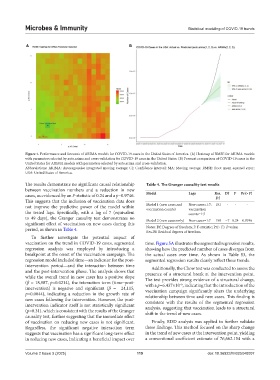
            Figure 4. Performance and forecasts of ARIMA models for COVID-19 cases in the United States of America. (A) Heatmap of RMSE for ARIMA models
            with parameters selected by auto.arima and cross-validation for COVID-19 cases in the United States. (B) Forecast comparison of COVID-19 cases in the
            United States for ARIMA models with parameters selected by auto.arima and cross-validation.
            Abbreviations: ARIMA: Autoregressive integrated moving average; CI: Confidence interval; MA: Moving average; RMSE: Root mean squared error;
            USA: United States of America.

            The results demonstrate no significant causal relationship   Table 4. The Granger causality test results
            between vaccination numbers and a reduction in new
            cases, as evidenced by an F-statistic of 0.24 and a p=0.9746.   Model  Lags     Res.  Df  F  Pr(> F)
                                                                                             Df
            This suggests that the inclusion of vaccination data does
            not improve the predictive power of the model within   Model 1 (new cases and   New cases=1:7;  151  -  -  -
                                                                                 vaccination
                                                               vaccination counts)
            the tested lags. Specifically, with a lag of 7 (equivalent           counts=1:7
            to  49  days), the  Granger  causality  test  demonstrates  no   Model 2 (new cases only)  New cases=1:7  158  −7 0.24 0.9746
            significant effect of vaccination on new cases during this
            period, as shown in Table 4.                       Notes: Df: Degrees of freedom; F: F-statistic; Pr(> F): P-value;
                                                               Res.Df: Residual degrees of freedom.
              To further investigate the potential impact of
            vaccination on the trend in COVID-19 cases, segmented   time. Figure 5A illustrates the segmented regression results,
            regression analysis was employed by introducing a   showing how the predicted number of cases diverges from
            breakpoint at the onset of the vaccination campaign. The   the actual cases over time. As shown in  Table S3, the
            regression model included time—an indicator for the post-  segmented regression results clearly reflect these trends.
            intervention period—and the interaction between time   Additionally, the Chow test was conducted to assess the
            and the post-intervention phase. The analysis shows that   presence of a structural break at the intervention point.
            while the overall trend in new cases has a positive slope   The test provides strong evidence of a structural change,
            (β = 18,987, p=0.0214), the interaction term (time–post-  with a p=6.437×10 , indicating that the introduction of the
                                                                              –6
            intervention) is negative and significant (β  = −24,115,   vaccination  campaign  significantly  alters  the  underlying
            p=0.0044), indicating a reduction in the growth rate of   relationship between time and new cases. This finding is
            new cases following the intervention. However, the post-  consistent with the results of the segmented regression
            intervention indicator itself is not statistically significant   analysis, suggesting that vaccination leads to a structural
            (p=0.31), which is consistent with the results of the Granger   shift in the trend of new cases.
            causality test, further suggesting that the immediate effect
            of vaccination on reducing new cases is not significant.   Finally, RDD analysis was applied to further validate
            Regardless, the significant negative interaction term   these findings. This method focused on the sharp change
            suggests that vaccination has a significant long-term effect   in the trend of new cases at the intervention point, yielding
            in reducing new cases, indicating a beneficial impact over   a conventional coefficient estimate of 76,662.154 with a


            Volume 2 Issue 3 (2025)                        119                           doi: 10.36922/MI025040007

