


Page 130 - MI-2-3
P. 130
Microbes & Immunity                                                  Statistical modeling of COVID-19 trends


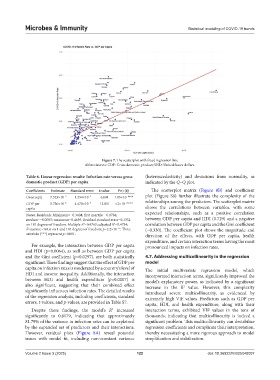
                                            Figure 7. The scatterplot with fitted regression line
                                     Abbreviations: GDP: Gross domestic product; USD: United States dollars.

            Table 6. Linear regression results: Infection rate versus gross   (heteroscedasticity) and deviations from normality, as
            domestic product (GDP) per capita                  indicated by the Q–Q plot.
            Coefficients  Estimate  Standard error  t‑value  Pr(>|t|)  The scatterplot matrix (Figure  8B) and coefficient
                                                       −8
            (Intercept)  7.523×10 −2  1.254×10 −2  6.001  1.05×10 ***  plot (Figure S8) further illustrate the complexity of the
            GDP per   5.736×10 −6  4.470×10 −7  12.831  <2×10 ***  relationships among the predictors. The scatterplot matrix
                                                      −16
            capita                                             shows the correlations between variables, with some
                                                               expected relationships, such as a positive correlation
            Notes: Residuals: Minimum=−0.3404; first quartile: −0.0784;
            median=−0.0503; maximum=0.4639. Residual standard error=0.1352   between GDP per capita and HDI (0.729) and a negative
                                     2
            on 181 degrees of freedom. Multiple R =0.4763; adjusted R =0.4734;   correlation between GDP per capita and the Gini coefficient
                                                  2
            F-statistic=164.6 on 1 and 181 degrees of freedom; p=2.2×10 . Three   (−0.330). The coefficient plot shows the  magnitude and
                                                   −16
            asterisks (***) represent p<0.001.                 direction of the effects, with GDP per capita, health
                                                               expenditure, and certain interaction terms having the most
              For example, the interaction between GDP per capita   pronounced impacts on infection rates.
            and HDI (p=0.0064), as well as between GDP per capita
            and the Gini coefficient (p=0.0297), are both statistically   4.7. Addressing multicollinearity in the regression
            significant. These findings suggest that the effect of GDP per   model
            capita on infection rates is moderated by a country’s level of   The  initial  multivariate  regression  model,  which
            HDI and income inequality. Additionally, the interaction   incorporated interaction terms, significantly improved the
            between HDI  and health expenditure  (p=0.0007)  is   model’s explanatory power, as indicated by a significant
            also significant, suggesting that their combined effect   increase in the  R  value. However, this complexity
                                                                               2
            significantly influences infection rates. The detailed results   introduced severe multicollinearity, as evidenced by
            of the regression analysis, including coefficients, standard   extremely high VIF values. Predictors such as GDP per
            errors, t-values, and p-values, are provided in Table S7.  capita, HDI, and health expenditure, along with their
                                                 2
              Despite these findings, the model’s  R  increased   interaction terms, exhibited VIF values in the tens of
            significantly to 0.8179, indicating that approximately   thousands, indicating that multicollinearity is indeed a
            81.79% of the variance in infection rates can be explained   significant problem. This multicollinearity can destabilize
            by the expanded set of predictors and their interactions.   regression coefficients and complicate their interpretation,
            However,  residual  plots  (Figure  8A) reveal  potential   thereby necessitating a more rigorous approach to model
            issues with model fit, including non-constant variance   simplification and stabilization.


            Volume 2 Issue 3 (2025)                        122                           doi: 10.36922/MI025040007

