


Page 125 - MI-2-3
P. 125
Microbes & Immunity                                                  Statistical modeling of COVID-19 trends


            A                                              B


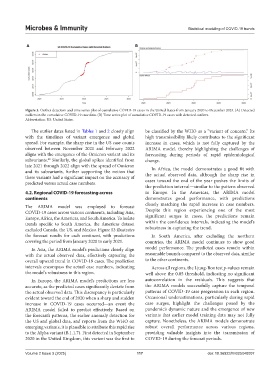
            Figure 3. Outlier detection and time series plot of cumulative COVID-19 cases in the United States from January 2020 to December 2023. (A) Detected
            outliers in the cumulative COVID-19 case data. (B) Time series plot of cumulative COVID-19 cases with detected outliers.
            Abbreviation: US: United States.

              The outlier dates listed in Tables 1 and 2 closely align   be classified by the WHO as a “variant of concern.” Its
            with the timelines of variant emergence and global   high transmissibility likely contributes to the significant
            spread. For example, the sharp rise in the US case counts   increase in cases, which is not fully captured by the
            observed between November 2021 and February 2022   ARIMA model, thereby highlighting the challenges of
            aligns with the emergence of the Omicron variant and its   forecasting  during  periods  of  rapid  epidemiological
            subvariants.  Similarly, the global spikes identified from   change.
                     40
            late 2021 through 2022 align with the spread of Omicron   In Africa, the model demonstrates a good fit with
            and its subvariants, further supporting the notion that
            these variants had a significant impact on the accuracy of   the actual observed data, although the sharp rise in
            predicted versus actual case numbers.              cases toward the end of the year pushes the limits of
                                                               the prediction interval—similar to the pattern observed
            4.2. Regional COVID-19 forecasting across          in  Europe.  In  the  Americas,  the  ARIMA  model
            continents                                         demonstrates  good  performance, with  predictions
                                                               closely  matching  the  rapid  increase  in  case  numbers.
            The ARIMA model was employed to forecast
            COVID-19 cases across various continents, including Asia,   Despite this region experiencing one of the most
            Europe, Africa, the Americas, and South America. To isolate   significant surges in cases, the predictions remain
            trends specific to South America, the Americas dataset   within the confidence intervals, indicating the model’s
            excluded Canada, the US, and Mexico. Figure S3 illustrates   robustness in capturing the trend.
            the forecast results for each continent, with predictions   In South America, after excluding the northern
            covering the period from January 2020 to early 2021.  countries, the ARIMA model continues to show good

              In Asia, the ARIMA model’s predictions closely align   model performance. The predicted cases remain within
            with the actual observed data, effectively capturing the   reasonable bounds compared to the observed data, similar
            overall upward trend in COVID-19 cases. The prediction   to the other continents.
            intervals encompass the actual case numbers, indicating   Across all regions, the Ljung-Box test p-values remain
            the model’s robustness in this region.             well above the 0.05 threshold, indicating no significant
              In Europe, the ARIMA model’s predictions are less   autocorrelation in the residuals. This suggests that
            accurate, as the predicted cases significantly deviate from   the ARIMA models successfully capture the temporal
            the actual observed data. This discrepancy is particularly   patterns of COVID-19 case progression in each region.
            evident toward the end of 2020 when a sharp and sudden   Occasional underestimations, particularly during rapid
            increase in  COVID-19  cases occurred—an  event the   case surges, highlight the challenges posed by the
            ARIMA model failed to predict effectively. Based on   pandemic’s dynamic nature and the emergence of new
            the forecast’s patterns, the earlier anomaly detection for   variants that earlier model training data may not fully
            the US and global data, and reports from the WHO on   capture. Nonetheless, the ARIMA models demonstrate
            emerging variants, it is plausible to attribute this rapid rise   robust overall performance across various regions,
            to the Alpha variant (B.1.1.7). First detected in September   providing valuable insights into the transmission of
            2020 in the United Kingdom, this variant was the first to   COVID-19 during the forecast periods.


            Volume 2 Issue 3 (2025)                        117                           doi: 10.36922/MI025040007

