


Page 124 - MI-2-3
P. 124
Microbes & Immunity                                                  Statistical modeling of COVID-19 trends


              Throughout these periods, the ARIMA model        Table 2. The detected outliers in COVID‑19 cases in the United
            demonstrates consistent predictive accuracy, although the   States of America from January 5 to December 27, 2020
            residual autocorrelation observed in the ACF and PACF   Date reported (year 2020)  Cumulative cases
            plots highlights areas for further refinement to improve
            model performance. These findings indicate that while   November 8                  9,920,253
            the ARIMA model effectively captures overall trends, it   November 15               10,925,098
            does not fully account for short-term dependencies or   December 13                 16,012,396
            sudden structural changes in the data. The presence of
            residual autocorrelation—especially mild positive lags   cumulative case data for both the US and global datasets.
            at short intervals—suggests the presence of unmodeled   This analysis aimed to identify time points where actual
            impacts, such as seasonal effects or external shocks. To   case numbers significantly deviated from expected
            address this, ARIMAX models incorporating vaccination   trends, potentially indicating periods associated with the
            rates as exogenous variables were then explored, with the   emergence and spread of new COVID-19 variants.
            findings discussed in Section 4.5, demonstrating improved
            performance in certain forecasting scenarios.        Figure  3A  displays the detected outliers in
                                                               COVID-19 cases in the US from January 5 to December
              Among the four forecast periods analyzed using ARIMA   27, 2020, with a summary of these outliers provided in
            models, the first forecast period demonstrates the lowest   Table S1. Notably, several of these dates align with the
            predictive accuracy. Several factors may contribute to this   emergence of significant COVID-19 variants—such as the
            discrepancy between the predicted and actual observed   Omicron  variant  (B.1.1.529)—which  was  first  identified
            data.  One  possibility is  the  inherent  limitation of  the   in November 2021 in South Africa and Botswana.  Other
                                                                                                       39
            ARIMA model itself—a linear model designed to predict   variants—such as BQ.1 and BQ.1.1—spread rapidly in
            future values based on past data. This model may struggle   late 2022, contributing to the increased number of cases
            to capture sudden  nonlinear changes or external shocks   that may have reduced predictive accuracy.   Figure  3B
                                                                                                   40
            that occur during the forecast period. ARIMA models   presents the time series plot of COVID-19 cases in the US,
            assume a degree of stationarity in the data. Therefore,
            structural breaks or sudden shifts in the underlying time   highlighting the detected outliers.
            series can reduce the reliability of the model’s predictions.  Further  analysis  was  conducted  on a  global
              Additionally, significant outliers or unexpected spikes   scale, with the results presented in  Figure S2. The
            in COVID-19 cases during the forecast period can affect   corresponding dates and case numbers for the detected
            predictive accuracy. Such anomalies may result from the   global outliers are summarized in Table S1. Similar to
            emergence of new virus variants, changes in public health   the US data, these global outliers correspond to key
            policies, or sudden shifts in public behavior. These rapid   dates when emerging variants—such as XBB, CH.1.1,
            increases in case numbers reduce the effectiveness of   and BF.7—were identified and began spreading across
            models trained solely on historical data.          various regions, leading to significant increases in case
                                                               numbers.  These variants, first reported in late 2022
                                                                       41
              To investigate this hypothesis, outlier detection analysis   and early 2023, significantly impacted regions such as
            was conducted on data from January 5 to December   Asia and Europe, leading to significant deviations from
            27, 2020. The identified outliers, shown in  Table  2   the predicted trends. 42
            and illustrated in Figure S1, highlight key dates where
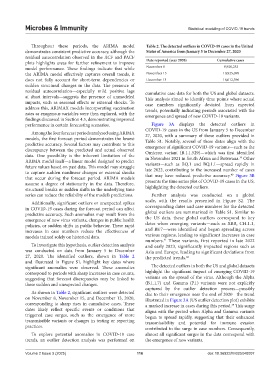
            significant anomalies were observed. These anomalies   The detected outliers in both the US and global datasets
            correspond to periods with sharp increases in case counts,   highlight the  significant  impact  of emerging COVID-19
            suggesting that forecast discrepancies may be linked to   variants on the spread of the virus. Although the Alpha
            these sudden and unexpected changes.               (B.1.1.7) and Gamma (P.1) variants were not explicitly
                                                               captured by the outlier detection process—possibly
              As shown in Table 2, significant outliers were detected   due to their emergence near the end of 2020—the trend
            on November 8, November 15, and December 13, 2020,   illustrated in Figure 3A (US outlier detection plot) exhibits
            corresponding to sharp rises in cumulative cases. These   a marked increase in cases during this period.  This surge
                                                                                                    39
            dates likely reflect specific events or conditions that   aligns with the period when Alpha and Gamma variants
            triggered case surges, such as the emergence of more   began to spread rapidly, suggesting that their enhanced
            transmissible variants or changes in testing or reporting   transmissibility and potential for immune evasion
            practices.                                         contributed to the surge in case numbers. Consequently,
              To  explore potential  anomalies  in COVID-19  case   almost all significant surges in the data correspond with
            trends,  an  outlier  detection  analysis  was  performed  on   the emergence of new variants.

            Volume 2 Issue 3 (2025)                        116                           doi: 10.36922/MI025040007

