


Page 146 - MI-2-3
P. 146
Microbes & Immunity                                                   Characterizing low-grade CNS tumors


            pattern was consistent with the SG staining results and   3.5. DNMT1 expression and epigenetic regulation
            confirms a predominance of CD11b  myeloid cells in   patterns
                                           +
            meningioma microenvironments.
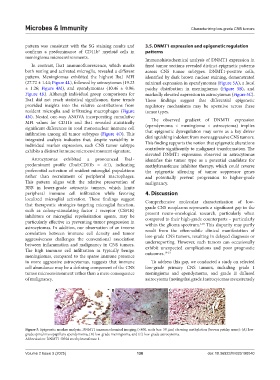
                                                               Immunohistochemical analysis of DNMT1 expression in
              In contrast, Iba1 immunofluorescence, which marks   fixed tumor sections revealed distinct epigenetic patterns
            both resting and activated microglia, revealed a different   across CNS tumor subtypes. DNMT1-positive cells,
            pattern. Meningiomas exhibited the  highest  Iba1  MFI   identified by dark brown nuclear staining, demonstrated
            (27.72 ± 1.44; Figure 4L), followed by astrocytomas (19.23   minimal expression in ependymomas (Figure 5A), a focal
            ±  1.26;  Figure  4M),  and ependymomas  (10.46  ± 0.96;   patchy distribution in meningiomas (Figure  5B), and
            Figure  4K). Although individual group comparisons for   markedly elevated expression in astrocytomas (Figure 5C).
            Iba1 did not reach statistical significance, these trends   These findings suggest that differential epigenetic
            provided insights into the relative contributions from   regulatory mechanisms may be operative across these
            resident microglia and infiltrating macrophages (Figure   tumor types.
            4N).  Nested  one-way  ANOVA  incorporating  cumulative
                                                                 The observed gradient of DNMT1 expression
            MFI values for CD11b and Iba1 revealed statistically   (ependymoma < meningioma < astrocytoma) implies
            significant differences in total mononuclear immune cell   that epigenetic dysregulation may serve as a key driver
            infiltration among all tumor subtypes (Figure  4O). This
            integrated analysis indicates that, despite variability in   distinguishing indolent from more aggressive CNS tumors.
            individual marker  expression, each CNS  tumor subtype   This finding supports the notion that epigenetic alterations
            exhibits a distinct immune microenvironment signature.  contribute significantly to malignant transformation. The
                                                               elevated  DNMT1  expression  observed  in  astrocytomas
              Astrocytomas  exhibited  a  pronounced  Iba1-    identifies this tumor type as a potential candidate for
            predominant profile (Iba1:CD11b = 4:1), indicating   methyltransferase inhibitor therapy, which could reverse
            preferential activation of resident microglial populations   the epigenetic silencing of tumor suppressor genes
            rather than recruitment of peripheral macrophages.   and potentially prevent progression to higher-grade
            This  pattern  aligns  with  the  relative  preservation  of   malignancy.
            BBB in lower-grade astrocytic tumors, which limits
            peripheral immune cell infiltration while favoring   4. Discussion
            localized  microglial  activation.  These  findings  suggest   Comprehensive molecular characterization of low-
            that therapeutic strategies targeting microglial function,   grade CNS neoplasms represents a significant gap in the
            such  as colony-stimulating factor  1  receptor  (CSF1R)   present neuro-oncological research, particularly when
            inhibitors or microglial repolarization agents, may be   compared to their high-grade counterparts – particularly
            particularly effective in preventing tumor progression in   within the glioma spectrum.  This disparity may partly
                                                                                      1,18
            astrocytomas. In addition, our observation of an inverse   result from the often-subtle clinical manifestation of
            correlation between immune cell density and tumor   low-grade CNS tumors, resulting in delayed diagnosis or
            aggressiveness challenges the conventional association
            between inflammation and malignancy in CNS tumors.   underreporting. However, such tumors can occasionally
            The high immune cell infiltration in typically benign   exhibit unexpected complications and poor prognostic
                                                                       19-21
            meningiomas, compared to the sparse immune presence   outcomes.
            in more aggressive astrocytomas, suggests that immune   To address this gap, we conducted a study on selected
            cell abundance may be a defining component of the CNS   low-grade  primary  CNS tumors,  including grade  I
            tumor microenvironment rather than a mere consequence   meningioma  and ependymoma,  and  grade  II diffused
            of malignancy.                                     astrocytoma (noting that grade I astrocytomas are extremely

                         A                       B                       C


            Figure 5. Epigenetic marker analysis. DNMT1 immunochemical imaging (×400, scale bar: 50 µm) showing methylation (brown patchy areas): (A) low-
            grade spinal myxopapillary ependymoma, (B) low-grade meningioma, and (C) low-grade astrocytoma.
            Abbreviation: DNMT1: DNA methyltransferase 1.


            Volume 2 Issue 3 (2025)                        138                           doi: 10.36922/MI025190040

