


Page 148 - MI-2-3
P. 148
Microbes & Immunity                                                   Characterizing low-grade CNS tumors


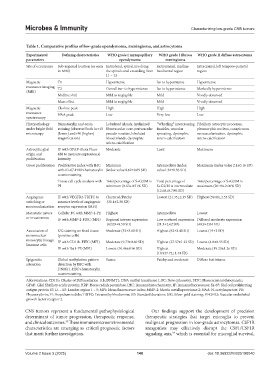
            Table 1. Comparative profiles of low‑grade ependymoma, meningioma, and astrocytoma
            Experimental   Defining characteristics  WHO grade I myxopapillary   WHO grade I fibrous   WHO grade II diffuse astrocytoma
            parameters                              ependymoma         meningioma
            Site of occurrence  Sub-regional location (as seen  Extradural, spinal, involving   Extracranial, midline   Intracranial, left temporo-parietal
                          in MRI)             the spinal canal extending from  basifrontal region  region
                                              L1 – L5
            Magnetic      T1                  Hypointense           Iso to hypointense  Hypointense
            resonance imaging   T2            Overall iso- to hyperintense  Iso to hyperintense  Markedly hyperintense
            (MRI)
                          Midline shift       Mild to negligible    Mild             Vividly observed
                          Mass effect         Mild to negligible    Mild             Vividly observed
            Magnetic      Choline peak        High                  High             High
            resonance     NAA peak            Low                   Very low         Low
            spectroscopy
            Histopathology   Hematoxylin and eosin   Lobulated islands, hyalinized   “Whorling” intercrossing  Fibrillary astrocytic processes,
            under bright field   staining (observed both in×10  fibrovascular core, perivascular  fascicles, vascular   pleomorphic nucleus, conspicuous
            microscopy    [lower] and×40 [higher]   pseudo-rosettes, lobulated   sprouting, dystrophic   neovascularization, dystrophic
                          magnification)      blood islands, dystrophic   micro-calcification  micro-calcification
                                              micro-calcification
            Astrocytic glial   IF with GFAP-Alexa Fluor   Moderate   Least           Maximum
            origin and    488 to measure expressional
            proliferation  intensity
            Gross proliferation Proliferative index with IHC   Minimum   Intermediate (index   Maximum (index value 2.1±0.16 SD)
                          with Ki-67-HRP+hematoxylin  (index value 0.62±0.09 SD)  value1.34±0.36 SD)
                          counterstaining
                          Tissue cell cycle analysis with  Total percentage of S+G2/M is   Total percentage of   Total percentage of S+G2/M is
                          PI                  minimum (8.63±0.51% SD)  S+G2/M is intermediate  maximum (20.40±2.06% SD)
                                                                    (12.60±0.70% SD)
            Angiogenic    IF with VEGFR2-TRITC to   Clustered/Patchy  Lowest (21.35±2.35 SD)  Highest (59.66±2.55 SD)
            switching or   measure levels of angiogenic    (30.1±2.38 SD)
            neovascularization receptor expression (MFI)
            Metastatic nature   Cellular FC with MMP-2-PE  Highest   Intermediate    Lowest
            or invasiveness  IF with MMP-2-FITC (MFI)  Regional intense expression  Low scattered expression  Diffused moderate expression
                                               (62.03±9.50 SD)      (21.3±2.62 SD)   (40.9±2.04 SD)
            Association of   S/G staining on fixed tissue   Moderate (32±3.60 SD)  Highest (62±3.40 SD)  Lowest (19±2 SD)
            mononuclear   (positive cells)
            monocytic lineage   IF with CD11b-FITC (MFI)  Moderate (9.73±0.60 SD)  Highest (27.57±1.23 SD) Lowest (4.8±0.55 SD)
            Immune cells
                          IF with Iba1-PE (MFI)  Lowest (10.46±0.96 SD)  Highest     Moderate (19.23±1.26 SD)
                                                                    (18.927.72±1.44 SD)
            Epigenetic    Global methylation pattern   Scarce       Patchy and moderate  Diffuse but intense
            alteration    detection by IHC with
                          DNMT1-HRP+hematoxylin
                          counterstaining
            Abbreviations: CD11b: Cluster of Differentiation 11b; DNMT1: DNA methyl transferase 1; FC: Flow cytometry; FITC: Fluorescein isothiocyanate;
            GFAP: Glial fibrillary acidic protein; HRP: Horse radish peroxidase; IHC: Immunohistochemistry; IF: Immunofluorescence; Ki-67: Kiel cell proliferating
            antigen protein 67; L1 – L5: Lumber region 1 – 5; MFI: Mean fluorescence index; MMP-2: Matrix metalloproteinase 2; NAA: N-acetylaspartate; PE:
            Phycoerythrin; PI: Propidium iodide; TRITC: Tetramethylrhodamine; SD: Standard deviation; S/G: Silver-gold staining; VEGFR2: Vascular endothelial
            growth factor receptor 2.

            CNS tumors represent a fundamental pathophysiological   Our findings support the development of precision
            determinant of tumor progression, therapeutic response,   therapeutic strategies that target microglia to prevent
            and clinical outcomes.  These immune microenvironmental   malignant progression in low-grade astrocytomas. CSF1R
                             33
            characteristics are emerging as critical prognostic factors   antagonists may effectively disrupt the CSF1/CSF1R
            that merit further investigation.                  signaling axis,  which is essential for microglial survival,
                                                                          34


            Volume 2 Issue 3 (2025)                        140                           doi: 10.36922/MI025190040

