


Page 155 - MI-2-3
P. 155
Microbes & Immunity                                                             Hyphae and healthspan


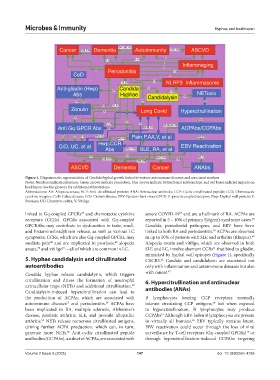
            Figure 1. Diagrammatic representation of Candida hyphal growth linked to various autoimmune diseases and associated markers
            Notes: Numbers indicate references. Green arrows indicate promotion, blue arrows indicate bidirectional relationships, and red boxes indicate impacts on
            healthspan. See the glossary for additional abbreviations.
            Abbreviations: AA: Alopecia areata; ACP: Anti-citrullinated protein; ANA: Antinuclear antibody; CCP: Cyclic citrullinated peptide; CCR: Chemotactic
            cytokine receptor; CeD: Celiac disease; CrD: Crohn’s disease; EBV: Epstein–Barr virus; GPCR: G-protein coupled receptor; Hwp: Hyphal wall protein; P:
            Psoriasis; UC: Ulcerative colitis; V: Vitiligo.

            linked to Gq-coupled GPCRs  and chemotactic cytokine   severe COVID-19  and are a hallmark of RA. ACPAs are
                                    35
                                                                             57
            receptors (CCRs). GPCRs associated with Gq-coupled   reported in 5 – 10% of primary Sjögren’s syndrome cases.
                                                                                                            58
            GPCRAbs may contribute to dysfunction in taste, smell,   Candida, periodontal pathogens, and EBV have been
            and histamine/bradykinin release, as well as various LC   linked to both RA and periodontitis.  ACPAs are observed
                                                                                            59
            symptoms. CCRs, which are also Gq-coupled GPCRs, may   in up to 50% of patients with SLE and arthritis (Rhupus).
                                                                                                            60
            mediate pain  and are implicated in psoriasis,  alopecia   Alopecia areata and vitiligo, which are observed in both
                                                  49
                      48
            areata,  and vitiligo —all of which are common in LC.  SLE and LC, involve aberrant CCRs  that bind to gliadin,
                            51
                                                                                            61
                 50
                                                               mimicked by hyphal wall epitopes (Figure 1), specifically
            5. Hyphae candidalysin and citrullinated           CXCR3.   Candida and candidalysin are associated not
                                                                     62
            autoantibodies                                     only with inflammation and autoimmune diseases but also
            Candida hyphae release candidalysin, which triggers   with cancer. 63
            citrullination and drives the formation of neutrophil   6. Hypercitrullination and antinuclear
            extracellular traps (NETs) and additional citrullination.
                                                         52
            Candidalysin-induced hypercitrullination can lead to   antibodies (ANAs)
            the production of ACPAs, which are associated with   B lymphocytes bearing CCP receptors normally
            autoimmune diseases  and periodontitis.  ACPAs have   tolerate  circulating  CCP  antigens,   but  when  exposed
                                              54
                             53
                                                                                           64
            been implicated in RA, multiple sclerosis, Alzheimer’s   to hypercitrullination, B lymphocytes may produce
            disease, psoriatic arthritis,  SLE, and juvenile idiopathic   CCPAbs  Although EBV-laden B lymphocytes are present
                                                                      53
                                                                                   65
            arthritis.  NETs release numerous citrullinated antigens,   in virtually all humans,  EBV typically remains latent.
                   55
            driving further ACPA production, which can, in turn,   EBV reactivation could occur through the loss of viral
                                                                                                          35
            generate more NETs.  Anti-cyclic citrullinated peptide   surveillance by T-cell receptors (Gq-coupled GPCRs)  or
                              56
            antibodies (CCPAbs), a subset of ACPAs, are associated with   through  hypercitrullination-induced  CCPAbs  targeting
            Volume 2 Issue 3 (2025)                        147                               doi: 10.36922/mi.4736

