


Page 10 - MI-2-4
P. 10
Microbes & Immunity                                        Regulation of Staphylococcus aureus CP biosynthesis


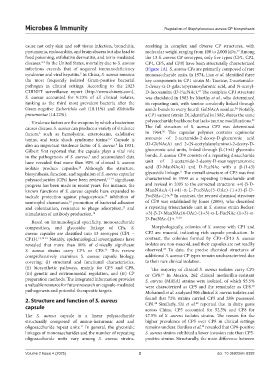
            cause not only skin and soft tissue infection, bronchitis,   resulting in complex and diverse CP structures, with
            pneumonia, endocarditis, and brain abscess but also lead to   molecular weight ranging from 100 to 2,000 kDa.  Among
                                                                                                      22
            food poisoning, exfoliative dermatitis, and toxin-mediated   the 13 S. aureus CP serotypes, only five types (CP1, CP2,
            diseases.  In the United States, mortality due to S. aureus   CP4, CP5, and CP8) have been structurally characterized
                   2-4
            infections exceeds that of acquired immunodeficiency   (Figure 1A). S. aureus CPs are primarily composed of rare
                                   5
            syndrome and viral hepatitis.  In China, S. aureus remains   monosaccharide units. In 1974, Liau et al. identified three
            the most frequently isolated Gram-positive bacterial   key components in CP1 strain M: Taurine, 2-acetamido-
            pathogen  in  clinical  settings.  According  to  the  2023   2-deoxy-α-D-galactopyranosyluronic acid, and N-acetyl-
            CHINET surveillance report (http://www.chinets.com),   D-fucosamine (D-FucNAc).  The complete CP1 structure
                                                                                     23
            S. aureus accounted for 9.23% of all clinical isolates,   was elucidated in 1983 by Murthy et al., who determined
            ranking as the third most prevalent bacteria after the   its repeating unit, with taurine covalently linked through
            Gram-negative  Escherichia  coli (18.11%) and  Klebsiella   amide bonds to every fourth GalNAcA residue.  Notably,
                                                                                                     24
            pneumoniae (14.22%).                               a CP1 variant (strain D), identified in 1982, shares the same
                                                                                                            25
              Virulence factors are the weapons by which a bacterium   polysaccharide backbone but lacks taurine modifications.
            causes disease. S. aureus can produce a variety of virulence   The full structure of S. aureus  CP2 was determined
                                                                      26
            factors,  such as hemolysins, enterotoxins, exfoliative   in 1964.  This capsular polymer contains equimolar
                  6
            toxins, and toxic shock syndrome toxins.  Capsule is   amounts of 2-acetamido-2-deoxy-D-glucuronic acid
                                               5,7
            also an important virulence factor of S. aureus.  In 1931,   (D-GlcNAcA) and 2-(N-acetylalanylamino)-2-deoxy-D-
                                                  8
            Gilbert first reported that the capsule plays a vital role   glucuronic acid units, linked through β-(1→4) glycosidic
                                       9
            in the pathogenesis of  S. aureus,  and accumulated data   bonds. S. aureus CP4 consists of a repeating disaccharide
            have revealed that more than 90% of clinical  S. aureus   unit  of  2-acetamido-2-deoxy-D-mannopyranuronic
            isolates produce capsules.  Although the structure,   acid (D-ManNAcA) and D-FucNAc with a  β-(1→3)
                                  10
                                                                              11
            biosynthesis, function, and regulation of S. aureus capsular   glycosidic linkage.  The overall structure of CP5 was first
            polysaccharides (CPs) have been reviewed, 11-14  significant   characterized in 1990 as a repeating trisaccharide unit
            progress has been made in recent years. For instance, the   and revised in 2005 to the corrected structure: →4)-β-D-
            known functions of  S. aureus  capsule have expanded to   ManNAcA-(1→4)-α-L-FucNAc(3-OAc)-(1→3)-β-D-
                                                                         20
            include protection against phagocytosis,  inhibition of   FucNAc-(1→.  In contrast, the revised chemical structure
                                             15
            neutrophil chemotaxis,  promotion of bacterial adhesion   of  CP8  was established  by Jones (2005),  who described
                              16
            and colonization, resistance to phage adsorption,  and   a repeating trisaccharide unit in S. aureus strain Becker:
                                                     17
            stimulation of antibody production. 18             →3)-β-D-ManNAc(4-OAc)-(1→3)-α-L-FucNAc-(1→3)-α-
                                                               D-FucNAc-(1→. 11,20
              Based on immunological specificity, monosaccharide
            composition, and glycosidic linkage of CPs,  S.      Morphologically, colonies of  S. aureus with CP1 and
            aureus capsules are classified into 13 serotypes (CP1 –   CP2 are mucoid, indicating rich capsule production.  In
            CP13). 14,19-21  Notably, epidemiological investigations have   contrast, the colonies formed by CP3–CP13  S. aureus
            revealed that more than 80% of clinically significant   isolates are non-mucoid, and their capsules are not readily
                                                                       27
            S. aureus strains carry CP5 or CP8.  This review   observed.  To date, the precise chemical structures of
                                              16
            comprehensively examines  S. aureus capsule biology,   additional S. aureus CP types remain uncharacterized due
            covering: (i) structural and functional characteristics,   to their rare clinical isolation.
            (ii)  biosynthetic  pathways,  mainly  for  CP5  and  CP8,   The  majority  of  clinical  S. aureus  isolates  carry  CP5
            (iii)  genetic  and  environmental  regulation,  and  (iv)  CP   or CP8.  In Mexico, 262 clinical methicillin-resistant
                                                                      16
            preparation methods. The integrated information provides   S.  aureus  (MRSA) strains were isolated, of which 93.5%
            a valuable resource for future research on capsule-mediated   were characterized as CP5 and the remainder as CP8.
                                                                                                            16
            pathogenesis and potential therapeutic targets.    Mohamed et al. analyzed 506 clinical S. aureus isolates and
            2. Structure and function of S. aureus             found that 72% strains carried CP5 and 28% possessed
                                                               CP8.  Similarly, Shi  et al.  reported that in dairy goats
                                                                                    29
                                                                   28
            capsule                                            across China, CP5 accounted for 52.5% and CP8 for
            The S. aureus capsule is a linear polysaccharide   47.5% of  S. aureus isolates strains. The reason for the
            structurally composed of amino-hexuronic acid and   higher prevalence of CP5 over CP8 in clinical settings
                                   11
                                                                                       30
            oligosaccharide repeat units.  In general, the glycosidic   remains unclear. Bardiau et al.  revealed that CP8-positive
            linkages of monosaccharides and the number of repeating   S. aureus strains exhibited a lower invasion rate than CP5-
            oligosaccharide units vary among  S. aureus strains,   positive strains. Structurally, the main difference between

            Volume 2 Issue 4 (2025)                         2                                doi: 10.36922/mi.8392

