


Page 14 - MI-2-4
P. 14
Microbes & Immunity                                        Regulation of Staphylococcus aureus CP biosynthesis


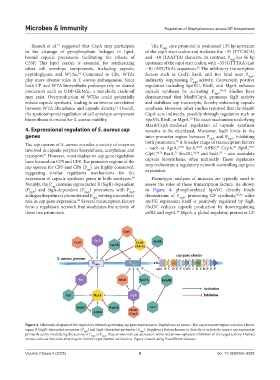
              Rausch  et al.  suggested that CapA may participate   The P SigA  core promoter is positioned 135 bp upstream
                         31
            in the cleavage of pyrophosphate linkages in lipid-  of the capA start codon and includes the −35 (TTCACA)
            bound capsule precursors, facilitating the release of   and −10 (TAATTA) elements. In contrast, P SigB  lies 56 bp
            C55P. This lipid carrier is essential for synthesizing   upstream of the capA start codon, with −35 (GTTTAA) and
            other cell envelope components, including capsule,   −10 (ATGTAA) sequences.  The inhibitory transcription
                                                                                     22
            peptidoglycan, and WTAs.  Compared to CPs, WTAs    factors such as CodY, SaeR, and Rot bind near P SigA ,
                                  14
            play more diverse roles in  S. aureus pathogenesis. Since   indirectly suppressing P SigB  activity. Conversely, positive
            both CP and WTA biosynthetic pathways rely on shared   regulators including SpoVG, RbsR, and MgrA enhance
            precursors such as UDP-GlcNAc, a metabolic trade-off   capsule synthesis by activating P SigB . 60-62  Studies have
            may  exist. Overproduction  of WTAs  could  potentially   demonstrated that MsaB/CspA promotes SigB activity
            reduce capsule synthesis, leading to an inverse correlation   and stabilizes cap transcripts, thereby enhancing capsule
            between WTA abundance and capsule density.  Overall,   synthesis. However, other studies reported that the MsaB/
                                                  12
            the spatiotemporal regulation of cell envelope component   CspA acts indirectly, possibly through regulators such as
            biosynthesis is crucial for S. aureus viability.   SpoVG, RbsR, or MgrA.  The exact mechanism underlying
                                                                                  63
                                                               MsaB/CspA-mediated regulation of capsule synthesis
            4. Expressional regulation of S. aureus cap        remains to be elucidated. Moreover, SaeR binds to the
            genes                                              inter-promoter region between P SigB  and P SigA , inhibiting
                                                                            18
            The cap operon of S. aureus encodes a variety of enzymes   both promoters.  A broader range of transcription factors
                                                                                                           70,71
                                                                                                    69
                                                                                     66,67
                                                                             64,65
                                                                                             68
            involved in capsule polymer biosynthesis, acetylation, and   – such as AgrA,   SarA,   ArlRS,  CcpA,  RpiR,
                                                                           73
                                                                    68,72
                                                                                              75
                                                                                   68,74
                    31
            transport.  However, most studies on cap gene regulation   ClpC,   RsaA,  SbcDC,   and SpdC  – also modulate
            have focused on CP5 and CP8. The promoter regions of the   capsule biosynthesis, often indirectly. These regulators
            cap operon for CP5 and CP8 (P ) are highly conserved,   may orchestrate a regulatory network controlling cap gene
                                      cap
            suggesting similar regulatory mechanisms for the   expression.
                                                         58
            expression of capsule synthesis genes in both serotypes.    Phenotypic analyses of mutants are typically used to
            Notably, the P contains sigma factor B (SigB)-dependent   assess the roles of these transcription factors. As shown
                       cap
            (P SigB ) and SigA-dependent (P SigA ) promoters, with P SigB    in  Figure  4, phosphorylated SpoVG directly binds
            acting as the primary promoter and P SigA  serving a secondary   downstream of P SigB , promoting CP synthesis, 60,76  while
            role in cap gene expression.  Several transcription factors   spoVG expression itself is positively regulated by SigB.
                                  59
            form a regulatory network that modulates the activity of   SbcDC  reduces  capsule  production  by  downregulating
            these two promoters.                               arlRS and mgrA.  MgrA, a global regulator, promotes CP
                                                                            74


            Figure 4. Schematic diagram of the regulatory network governing cap gene expression in Staphylococcus aureus. The cap promoter region contains a factor
            sigma B (SigB)-dependent promoter (P SigB ) and SigA-dependent promoter (P SigA ). Regulatory factors known to directly or indirectly impact cap expression
            primarily act by modulating the activity of P SigB  or P SigA . Blue arrows indicate activation, while red arrows represent inhibition of the target activity. Dashed
            arrows indicate functions that require further experimental verification. Figure created using PowerPoint software.


            Volume 2 Issue 4 (2025)                         6                                doi: 10.36922/mi.8392

