


Page 161 - MI-2-4
P. 161
Microbes & Immunity                                                  A novel anti-EphA8 monoclonal antibody


            2.5. Determination of K  by flow cytometry          A
                                D
            CHO/EphA8  and LN229/EphA8 were suspended
            in 100  μL of serially diluted Ea Mab-9  (10  μg/mL to
                                        8
            0.0006  μg/mL),  followed  by  treatment  with  Alexa  Fluor
            488-conjugated anti-mouse IgG (1:200).  Fluorescence
            data were subsequently collected using the BD FACSLyric
            system (BD Biosciences, USA). The dissociation constant
            (K ) was calculated by fitting the binding isotherms into
              D
            the built-in one-site binding model in GraphPad PRISM 6   B
            (GraphPad Software Inc., USA).
            2.6. Determination of K  by enzyme-linked
                                D
            immunosorbent assay (ELISA)
            The recombinant EphA8-Fc (recEphA8) (Sino Biological
            Inc., China) was immobilized on Nunc Maxisorp 96-well
            immunoplates (Thermo Fisher Scientific Inc., USA) at
            10 μg/mL for 30 min at 37°C. After washing with PBS containing   C
            0.05% Tween20 (PBST; Nacalai Tesque Inc., Japan), wells were
            blocked with 1% BSA in PBST for 30 min at 37°C. The plates
            were then incubated at serially diluted Ea Mab-9 (10 μg/mL
                                            8
            to 0.0006  μg/mL), followed by treatment with peroxidase-
            conjugated anti-mouse IgG (1:2000; SouthernBiotech, USA).
                                 1
            Finally, enzymatic reactions were conducted using the ELISA
            POD substrate TMB kit (Nacalai Tesque Inc., Japan). The K
                                                         D
            value was determined as described above.
            3. Results
            3.1. Development of anti-EphA8 mAbs using the       D
            CBIS method
            Currently, polyclonal antibodies against EphA8 for flow
            cytometry are commercially available. However, they
            are  insufficient  for  therapeutic  applications.  Therefore,
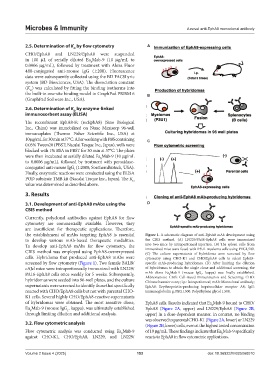
            the establishment of mAbs targeting EphA8 is essential   Figure 1. A schematic diagram of anti-EphA8 mAb development using
            to develop various mAb-based therapeutic modalities.   the CBIS method. (A) LN229/PA16-EphA8  cells were immunized
            To develop anti-EphA8 mAbs for flow cytometry, the   into two mice by intraperitoneal injection. (B) The spleen cells from
            CBIS method was employed using EphA8-overexpressed   immunized mice were fused with P3U1 myeloma cells using PEG1,500.
                                                               (C)  The  culture  supernatants  of  hybridoma  were  screened  by  flow
            cells.  Hybridoma that  produced anti-EphA8  mAbs  were   cytometry using  CHO-K1  and  CHO/EphA8  cells to  select EphA8-
            screened by flow cytometry (Figure 1). Two female BALB/  specific mAb-producing hybridomas. (D) After limiting the dilution
            cAJcl mice were intraperitoneally immunized with LN229/  of hybridomas to obtain the single clone and additional screening, the
            PA16-EphA8 cells once weekly for 5 weeks. Subsequently,   mAb clone Ea Mab-9 (mouse IgG , kappa) was finally established.
                                                                         8
                                                                                       1
            hybridomas were seeded into 96-well plates, and the culture   Abbreviations: CBIS: Cell-Based Immunization and Screening; CHO:
                                                               Chinese hamster ovary; i.p.: Intraperitoneal; mAb: Monoclonal antibody;
            supernatants were screened to identify those that specifically   EphA8:  Erythropoietin-producing  hepatocellular  receptor  A8;  IgG:
            reacted with CHO/EphA8 cells but not with parental CHO-  immunoglobulin g; PEG1,500: Polyethylene glycol 1,500.
            K1 cells. Several highly CHO/EphA8-reactive supernatants
            of hybridomas were obtained. The most sensitive clone,   EphA8 cells. Results indicated that Ea Mab-9 bound to CHO/
                                                                                           8
            Ea Mab-9 (mouse IgG , kappa), was ultimately established   EphA8  (Figure  2A,  upper)  and  LN229/EphA8  (Figure  2B,
                              1
              8
            through limiting dilution and additional analysis.  upper) in a dose-dependent manner. In contrast, no binding
                                                               was observed to parental CHO-K1 (Figure 2A, lower) or LN229
            3.2. Flow cytometric analysis                      (Figure 2B, lower) cells, even at the highest tested concentration
            Flow  cytometric  analysis  was  conducted  using  Ea Mab-9   of 10 μg/mL. These findings indicate that Ea Mab-9 specifically
                                                     8
                                                                                               8
            against CHO-K1, CHO/EphA8, LN229, and LN229/       reacts to EphA8 in flow cytometric applications.
            Volume 2 Issue 4 (2025)                        153                           doi: 10.36922/MI025060010

