


Page 163 - MI-2-4
P. 163
Microbes & Immunity                                                  A novel anti-EphA8 monoclonal antibody


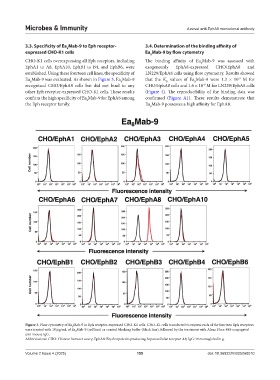
            3.3. Specificity of Ea Mab-9 to Eph receptor-      3.4. Determination of the binding affinity of
                             8
            expressed CHO-K1 cells                             Ea Mab-9 by flow cytometry
                                                                 8
            CHO-K1 cells overexpressing all Eph receptors, including   The binding affinity of Ea Mab-9 was assessed with
                                                                                      8
            EphA1 to A8, EphA10, EphB1 to B4, and EphB6, were   exogenously  EphA8-expressed  CHO/EphA8   and
            established. Using these fourteen cell lines, the specificity of   LN229/EphA8 cells using flow cytometry. Results showed
            Ea Mab-9 was evaluated. As shown in Figure 3, Ea Mab-9   that  the  K   values  of  Ea Mab-9  were  1.3  ×  10   M  for
                                                                                                      -9
              8
                                                                                    8
                                                                        D
                                                    8
            recognized CHO/EphA8  cells but did not bind to any   CHO/EphA8 cells and 1.6 × 10  M for LN229/EphA8 cells
                                                                                       -9
            other Eph receptor-expressed CHO-K1 cells. These results   (Figure  4). The reproducibility of the binding data was
            confirm the high specificity of Ea Mab-9 for EphA8 among   confirmed (Figure A1). These results demonstrate that
                                      8
            the Eph receptor family.                           Ea Mab-9 possesses a high affinity for EphA8.
                                                                 8


            Figure 3. Flow cytometry of Ea Mab-9 in Eph receptor-expressed CHO-K1 cells. CHO-K1 cells transfected to express each of the fourteen Eph receptors
                                8
            were treated with 10 μg/mL of Ea Mab-9 (red line) or control blocking buffer (black line), followed by the treatment with Alexa Fluor 488-conjugated
                                 8
            anti-mouse IgG.
            Abbreviations: CHO: Chinese hamster ovary; EphA8: Erythropoietin-producing hepatocellular receptor A8; IgG: immunoglobulin g.
            Volume 2 Issue 4 (2025)                        155                           doi: 10.36922/MI025060010

