


Page 26 - MI-2-4
P. 26
Microbes & Immunity                                               Infectious agents and autoimmune diseases


            misdirection by infectious agents (bacteria, viruses,
            etc.),  often in  conjunction with  environmental factors.
            Current mainstream treatments aimed at relieving
            symptoms are mainly based on immunosuppressive or
                                  8
            immunomodulatory drugs.  Despite these advances, the
            precise mechanism and etiology of autoimmune diseases
            remain unclear. 9
              This paper is focused on the mechanism that underlies
            the autoimmune response. A  general conceptual model
            and evidence supporting its plausibility are outlined
            and discussed. Moreover, several new explanations of
            autoimmune response features that can be derived from
            the model are presented and briefly discussed. Finally,
            research directions aimed at the development of new
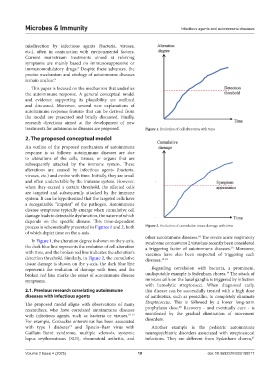
            treatments for autoimmune diseases are proposed.   Figure 1. Evolution of cell alteration with time

            2. The proposed conceptual model
            An outline of the proposed mechanism of autoimmune
            response is as follows: autoimmune diseases are due
            to alterations of the cells, tissues, or organs that are
            subsequently attacked by the immune system. These
            alterations are caused by infectious agents (bacteria,
            viruses, etc.) and evolve with time. Initially, they are small
            and often undetectable by the immune system. However,
            when they exceed a certain threshold, the affected cells
            are targeted and subsequently attacked by the immune
            system. It can be hypothesized that the targeted cells have
            a recognizable “imprint” of the pathogen. Autoimmune
            disease symptoms typically emerge when cumulative cell
            damage leads to detectable dysfunction, the nature of which
            depends on the specific disease. This time-dependent
            process is schematically presented in Figures 1 and 2, both   Figure 2. Evolution of cumulative tissue damage with time
            of which depict time on the x-axis.
                                                                                     14
                                                               other autoimmune diseases.  The severe acute respiratory
              In Figure 1, the alteration degree is shown on the y-axis,   syndrome coronavirus 2 virus has recently been considered
            the dark blue line represents the evolution of cell alteration   a  triggering factor of autoimmune diseases.  Moreover,
                                                                                                   15
            with time, and the broken red line indicates the alteration’s   vaccines have also been suspected of triggering such
            detection threshold. Similarly, in Figure 2, the cumulative   diseases. 16-18
            tissue damage is shown on the y-axis, the dark blue line
            represents the evolution of damage with time, and the   Regarding correlation with bacteria, a prominent,
                                                                                                 19
            broken red line marks the onset of autoimmune disease   undisputable example is Sydenham chorea.  The attack of
            symptoms.                                          immune cells on the basal ganglia is triggered by infection
                                                               with  hemolytic  streptococci.  When  diagnosed  early,
            2.1. Previous research correlating autoimmune      this disease can be successfully treated with a high dose
            diseases with infectious agents                    of antibiotics, such as penicillin, to completely eliminate
            The proposed model aligns with observations of many   Streptococcus. This is followed by a lower long-term
                                                                             20
            researchers, who have correlated autoimmune diseases   prophylaxis dose.  Recovery  -  and eventually cure  -  is
            with infectious agents, such as bacteria or viruses. 10-12    manifested  by  the gradual  elimination  of  movement
            For example, Coxsackie enterovirus has been associated   disorders.
            with type  1 diabetes  and Epstein–Barr virus with   Another example is the pediatric autoimmune
                              13
            Guillain–Barré syndrome, multiple sclerosis, systemic   neuropsychiatric disorders associated with streptococcal
            lupus erythematosus (SLE), rheumatoid arthritis, and   infections. They are different from Sydenham chorea,
                                                                                                            21

            Volume 2 Issue 4 (2025)                         18                           doi: 10.36922/MI025100017

