


Page 27 - MI-2-4
P. 27
Microbes & Immunity                                               Infectious agents and autoimmune diseases


            and, as their name denotes, they are directly related to   Table 1. Correlations between common autoimmune
            infections by gram-positive or spherical bacteria.  diseases and specific pathogens
              Moreover, inflammatory  bowel diseases, comprising   Autoimmune             Pathogens
            Crohn’s disease and ulcerative colitis, have been related to   disease
            gastrointestinal pathogens, such as Campylobacter species,   Crohn’s disease  Campylobacter species, Salmonella species,
            Salmonella  species, enterohepatic Helicobacter  species,         enterohepatic Helicobacter species,
            Mycobacterium avium paratuberculosis,  Clostridioides             Mycobacterium avium paratuberculosis,
                                                                              Clostridioides difficile, and Listeria
            difficile,  and  Listeria monocytogenes.   Notably,  several      monocytogenes
                                           22
            gastrointestinal microbes and intestinal helminths have   Graves’s disease  Hepatitis C virus, Coxsackie virus, Yersinia
            been inversely associated with the risk of inflammatory           enterocolitica, Borrelia burgdorferi, Helicobacter
            bowel diseases. 23                                                pylori, and retroviruses
              Similarly, autoimmune thyroid diseases, namely,   Guillain-Barré   Campylobacter jejuni, cytomegalovirus,
            Graves’s and Hashimoto’s diseases, have been correlated   syndrome  Epstein-Barr virus, influenza A virus,
                                                                              Mycoplasma pneumoniae, and Haemophilus
            with many types of infectious agents, such as hepatitis C         influenzae
            virus, Coxsackie virus,  Yersinia enterocolitica,  Borrelia   Hashimoto’s disease  Hepatitis C virus, Coxsackie virus, Yersinia
            burgdorferi, Helicobacter pylori, and retroviruses. 24            enterocolitica, Borrelia burgdorferi, Helicobacter
              Other autoimmune diseases could also be induced or              pylori, and retroviruses
            exacerbated by many different microbial infections, as   Multiple sclerosis  Herpes, viruses of the human endogenous
            summarized by Von Herrath et al.  Multiple sclerosis, for         retrovirus family, protozoa, and bacteria
                                       25
            instance, has been related to viruses of the herpes  and the   PANDAS  Gram-positive or spherical bacteria.
                                                   26
            human endogenous retrovirus families, as well as protozoa   Rheumatoid arthritis Epstein-Barr virus
            and bacteria.  At the same time, Guillain-Barré syndrome   Sjogren’s syndrome  Epstein-Barr virus and hepatitis C virus
                      27
            has been associated mainly with  Campylobacter jejuni,   Sydenham chorea  Hemolytic streptococcus
            cytomegalovirus, Epstein-Barr virus, influenza A virus,   Systemic lupus   Epstein-Barr virus
            Mycoplasma pneumoniae, and Haemophilus influenzae.  In   erythematosus
                                                       28
            addition,  primary  Sjögren’s  syndrome  has  been  related  to   Type 1 diabetes  Coxsackie enterovirus
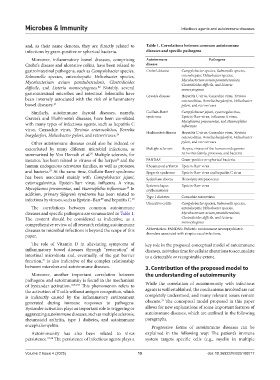
            infections by viruses, such as Epstein–Barr  and hepatitis C. 30
                                            29
                                                               Ulcerative colitis  Campylobacter species, Salmonella species,
              The  correlations  between  common  autoimmune                  enterohepatic Helicobacter species,
            diseases and specific pathogens are summarized in Table 1.        Mycobacterium avium paratuberculosis,
            The content should be considered as indicative, as a              Clostridioides difficile, and Listeria
            comprehensive review of all research relating autoimmune          monocytogenes
            diseases to microbial infections is beyond the scope of this   Abbreviation: PANDAS: Pediatric autoimmune neuropsychiatric
            paper.                                             disorders associated with streptococcal infections.
              The role of Vitamin D in alleviating symptoms of   key role in the proposed conceptual model of autoimmune
            inflammatory bowel diseases through “restoration” of   diseases, as it takes time for cellular alterations to accumulate
            intestinal microbiota and, eventually, of the gut barrier   to a detectable or recognizable extent.
            function,  is also indicative of the complex relationship
                   31
            between microbes and autoimmune diseases.          3. Contribution of the proposed model to
              Moreover, another important correlation between   the understanding of autoimmunity
            pathogens and autoimmunity is found in the mechanism
            of bystander activation. 10,32,33  This phenomenon refers to   While the correlation of autoimmunity with infectious
            the activation of T cells without antigen recognition, which   agents is well established, the mechanisms involved are not
            is indirectly caused by the inflammatory environment   completely understood, and many relevant issues remain
                                                                      35
            generated during immune responses to pathogens.    obscure.  The conceptual model proposed in this paper
            Bystander activation plays an important role in triggering or   allows for new explanations of some important features of
            aggravating autoimmune diseases, such as multiple sclerosis,   autoimmune diseases, which are outlined in the following
            rheumatoid arthritis, type  1 diabetes, and autoimmune   paragraphs.
            encephalomyelitis.                                   Progressive forms of autoimmune diseases can be
              Autoimmunity has also been related to virus      explained in the following way: The patient’s immune
            persistence. 33,34  The persistence of infectious agents plays a   system targets specific cells (e.g., myelin in multiple


            Volume 2 Issue 4 (2025)                         19                           doi: 10.36922/MI025100017

