


Page 142 - MSAM-4-2
P. 142
Materials Science in Additive Manufacturing Bi-modal powder spreading behavior of ceramics
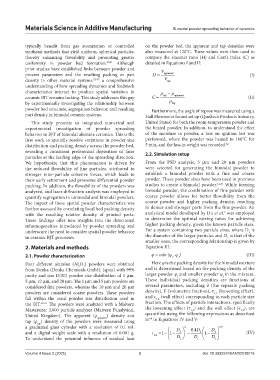
typically benefit from gas atomization or controlled on the powder bed, the apparent and tap densities were
synthesis methods that yield uniform, spherical particles, also measured at 120°C. These values were then used to
thereby enhancing flowability and promoting greater compute the Hausner ratio (H) and Carr’s index (C) as
uniformity in powder bed formation. 50,51 Although detailed in Equations I and II:
prior studies have established links between powder and V
process parameters and the resulting packing or part H = apparent (I)
density in other material systems, 52-57 a comprehensive V tap
understanding of how spreading dynamics and feedstock
characteristics interact to produce spatial variation in ρ − ρ
ceramic BJT remains lacking. This study addresses this gap C = tap apparent (II)
by experimentally investigating the relationship between ρ tap
powder bed structure, segregation behavior, and resulting Furthermore, the angle of repose was measured using a
part density in bimodal ceramic systems. Hall Flowmeter funnel set up (Qualtech Products Industry,
This study presents an integrated numerical and United States) for both the room-temperature powder and
experimental investigation of powder spreading the heated powder. In addition, to understand the effect
behavior in BJT of bimodal alumina ceramics. This is the of the moisture in powder, a loss on ignition test was
first work to spatially resolve variations in powder size performed, where the powder was heated to 160°C for
distribution and packing density across the powder bed, 5 min, and the loss in weight was recorded. 62
revealing a consistent preferential deposition of finer 2.2. Simulation setup
particles at the leading edge of the spreading direction.
We hypothesize that this phenomenon is driven by From the PSD analysis, 5 µm and 20 µm powders
the reduced flowability of fine particles, attributed to were selected for generating the bimodal powder to
stronger inter-particle cohesive forces, which leads to establish a bimodal powder with a fine and coarse
their early settlement and promotes differential powder powder. These powder sizes have been used in previous
packing. In addition, the flowability of the powders was studies to create a bimodal powder. 61,63 While forming
analyzed, and laser diffraction analysis was employed to bimodal powder, the combination of fine powder with
quantify segregation in unimodal and bimodal powders. coarse powder allows for better flowability from the
The impact of these spatial powder characteristics was coarse powder and higher packing density, resulting
further assessed by correlating local bed packing density in denser and stronger parts from the fine powder. An
3
with the resulting relative density of printed parts. analytical model developed by Du et al. was employed
These findings offer new insights into the directional to determine the optimal mixing ratios for achieving
inhomogeneities introduced by powder spreading and higher packing density, given the known particle sizes.
underscore the need to consider spatial powder behavior For a system containing two particle sizes, where D is
1
in ceramic BJT processes. the diameter of the larger particles and D is that of the
2
smaller ones, the corresponding relationship is given by
2. Materials and methods Equation III:
2.1. Powder characterization φ = min (φ , φ ) (III)
1
2
Four different alumina (Al O ) powders were obtained Here φ is the packing density for the bimodal mixture
2
3
from Denka (Denka Chemicals GmbH, Japan) with 99% and is determined based on the packing density of the
purity and size D(50) powder size distribution of 1 µm, larger powder φ and smaller powder φ in the mixture.
1
2
5 µm, 10 µm, and 20 µm. The 1 µm and 5 µm powders are These individual packing densities are functions of
considered fine powders, whereas the 10 µm and 20 µm several parameters, including ∂ (the separate packing
powders are considered coarse powders. These powders density), F (volumetric fraction), τ (loosening effect),
1,2
fall within the usual powder size distribution used in and ϵ (wall effect) corresponding to each particle size
1,2
the BJT. 58-61 The powders were analyzed with a Malvern fraction. The effects of particle interactions, specifically
Mastersizer 3,000 particle analyzer (Malvern Panalytical, the loosening effect (τ ) and the wall effect (ϵ ), are
1,2
1,2
United Kingdom). The apparent (ρ apparent ) density and quantified using the following expressions as described
64
tap (ρ ) density of the powders were measured using in in Equations IV and V:
tap
a graduated glass cylinder with a resolution of 0.1 mL D 2 04 . D D 37.
and a digital weight scale with a resolution of 0.001 g. 12, =− 1− 2 − 2 1− 2 (IV)
1
To understand the potential influence of residual heat D 1 D 1 D 1
Volume 4 Issue 2 (2025) 3 doi: 10.36922/MSAM02510016

