


Page 144 - MSAM-4-2
P. 144
Materials Science in Additive Manufacturing                    Bi-modal powder spreading behavior of ceramics


                         A                                                 B


                                                                           C


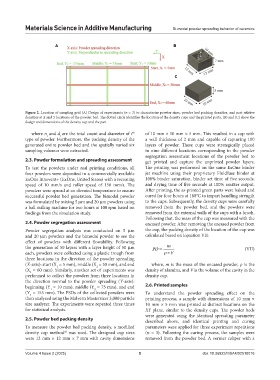
            Figure 2. Location of sampling grid (A) Design of experiments (n = 3) to characterize powder sizes, powder bed packing densities, and part relative
            densities at X and Y locations of the powder bed. The dotted circle identifies the location of the density cups and the printed parts. (B) and (C) show the
            design and dimensions of the density cup and the part

              where n and d are the total count and diameter of i    of 10 mm × 10 mm × 5 mm. This resulted in a cup with
                                                         th
                     i
                           i
            type of powder. Furthermore, the packing density of the   a  wall  thickness of  2  mm  and capable  of capturing  100
            generated entire powder bed and the spatially varied six   layers of powder. These cups were strategically placed
            sampling volumes were extracted.                   in nine different locations corresponding to the powder
                                                               segregation assessment locations of the powder bed to
            2.3. Powder formulation and spreading assessment   get  printed  and  capture  the  unprinted  powder  layers.
            To test the powders under real printing conditions, all   The printing was performed on the same ExOne binder
            four powders were deposited in a commercially available   jet machine using their proprietary Fluidfuse binder at
            ExOne Innovent+ (ExOne, United States) with a recoating   100% binder saturation, binder set time of five seconds,
            speed of  10  mm/s  and roller speed  of 150  mm/s.  The   and drying time of five seconds at 100% emitter output.
            powders were spread at an elevated temperature to ensure   After printing, the as-printed green parts were baked and
            successful powder bed generation. The bimodal powder   cured for four hours at 180°C to impart handling strength
            was formulated by mixing 5 µm and 20 µm powders using   to the cups. Subsequently, the density cups were carefully
            a ball milling machine for two hours at 100 rpm based on   removed from the powder bed, and the powders were
            findings from the simulation study.                removed from the external walls of the cups with a brush.
                                                               Following that, the mass of the cup was measured with the
            2.4. Powder segregation assessment                 encased powder. After removing the encased powder from
            Powder segregation analysis was conducted on 5  µm   the cup, the packing density of the location of the cup was
            and 20 µm powders and the bimodal powder to see the   calculated based on Equation VII:
            effect of  powders  with  different  flowability.  Following
            the generation of 50 layers with a layer height of 50 µm   PD =  m                           (VII)
            each, powders were collected using a plastic trough from   ρ × V
            three locations in the direction of the powder spreading
            (X-axis): start (X  = 5 mm), middle (X  = 30 mm), and end   where, m is the mass of the encased powder, ρ is the
                         1
                                          2
            (X  = 60 mm). Similarly, another set of experiments was   density of alumina, and V is the volume of the cavity in the
              3
            performed to collect the powders from three locations in   density cup.
            the direction normal to the powder spreading (Y-axis):
            beginning (Y  = 10 mm), middle (Y  = 75 mm), and end   2.6. Printed samples
                      1
                                         2
            (Y  = 155 mm). The PSDs of the collected powders were   To  understand  the  powder  spreading  effect  on  the
              3
            then analyzed using the Malvern Mastersizer 3,000 particle   printing process, a sample with dimensions of 10 mm ×
            size analyzer. The experiments were repeated three times   10 mm × 5 mm was printed at distinct locations on the
            for statistical analysis.                          XY plane, similar to the density cups. The powder beds
                                                               were generated using the identical spreading parameter
            2.5. Powder bed packing density                    described above, and identical printing and curing
            To measure the powder bed packing density, a modified   parameters were applied for three experiment repetitions
            density cup method  was used. The designed cup sizes   (n = 3). Following the curing process, the samples were
                            66
            were 12 mm × 12 mm × 7 mm with cavity dimensions   removed from the powder bed. A vernier caliper with a

            Volume 4 Issue 2 (2025)                         5                          doi: 10.36922/MSAM02510016

