


Page 78 - OR-1-1
P. 78
disease mechanisms and screen potential drugs in a more   the accumulation of α-synuclein, the loss of dopaminergic
            physiologically relevant environment compared to 2D   neurons, and the activation of microglia.  These organoids
                                                                                              149
            cultures. 138,139,143,144                         mimic the substantia nigra dopaminergic neurons, which
                                                              are essential for dopamine signaling to the basal ganglia.
            5.2.2.1. MBO model                                They include not only midbrain dopaminergic neurons
            Using chemically defined methods to differentiate   expressing tyrosine hydroxylase (TH) but also astrocytes
            midbrain floor plate neural progenitor cells (mfNPCs)   and oligodendrocytes. These organoids are capable of
            from pluripotent stem cells provides a crucial starting point   forming complex neurotransmitter responses and possess
            for generating midbrain-specific organoids (MBO).  By   the structure and function of autonomous neural networks.
                                                       145
            applying key factors such as fibroblast growth factor 8 (Fgf8),   Studies have shown that these mfNPCs  can effectively
            WNT signaling pathway, SHH, and dual SMAD inhibitors,   differentiate into 2D midbrain dopaminergic neurons
            researchers have successfully guided the differentiation of   (mDAN) and 3D human midbrain-specific organoids
            dopaminergic neurons. 146-148  (Figure 1). MBO models have   (hMO), highly expressing markers associated with
            captured key pathological features of the disease, including   midbrain dopaminergic neurons, such as TH, FOXA2,

             A                                        B


                                                       C


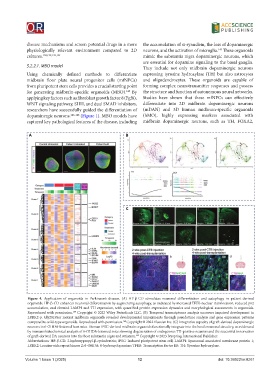
             Figure  4.  Application of organoids in Parkinson’s disease. (A) HP-β-CD stimulates neuronal differentiation and autophagy in patient-derived
             organoids. HP-β-CD enhances neuronal differentiation by augmenting autophagy, as indicated by increased TFEB nuclear translocation, reduced p62
             accumulation, and elevated LAMP1 and TH expression, with quantified protein expression dynamics and morphological assessments in organoids.
             Reproduced with permission.  Copyright © 2022 Wiley Periodicals LLC. (B) Temporal transcriptome analysis uncovers impaired development in
                                159
             LRRK2-p. Gly2019Ser mutant midbrain organoids revealed developmental impairments through pseudotime analysis and gene expression patterns
             compared to wild-type organoids. Reproduced with permission. Copyright © 2022 Elsevier Inc. (C) Integrative capacity of graft-derived dopaminergic
                                                     160
             neurons in 6-OHDA-lesioned host mice. Human iPSC-derived midbrain organoids functionally integrate into the host’s neuronal circuitry, as evidenced
             by immunohistochemical analysis of 6-OHDA-lesioned mice showing degeneration of endogenous TH-positive neurons and the successful innervation
             of graft-derived DA neurons into the host substantia nigra and striatum.  Copyright © 2023 Ivyspring International Publisher.
                                                           164
             Abbreviations: HP-β-CD: 2-hydroxypropyl-β-cyclodextrin; iPSC: Induced pluripotent stem cell; LAMP1: Lysosomal associated membrane protein 1;
             LRRK2: Leucine-rich repeat kinase 2; 6-OHDA: 6-hydroxydopamine; TFEB: Transcription factor EB; TH: Tyrosine hydroxylase.

            Volume 1 Issue 1 (2025)                         12                                doi: 10.36922/or.8261

