


Page 115 - OR-1-2
P. 115
establishing and developing co-cultivation systems. These   model capable of simulating cell interactions, dynamic
            co-culture systems integrate some components of the tumor   drug concentrations and drug effects, and angiogenesis or
            microenvironment (such as stromal cells and immune   mechanical stimulation of cells. 84,85  This advancement will
            cells), which will be an important development direction   bridge the gap in drug responses observed in in vitro studies
            for cancer organoids in the future. 78-83         and  real  patients  and  enable  a more  accurate  simulation
                                                              of  the  tumor  microenvironment.   Different  microfluidic
                                                                                         86
               Given the limitations of organoids, Organ-on-Chip
            is emerging as an innovative platform to optimize cancer   organ chips can be connected to each other to construct
                                                              a human chip model capable of simulating multi-organ
            organoids. Cancer organoids are 3D cell cultures derived   interactions. These microphysiological systems can be used
            from patient tumors that retain key genetic and histological   to  study  cancer  multi-organ  metastasis.   Shirure  et al.
                                                                                                            88
                                                                                               87
            features of the original cancer. Thus, organoids are self-  reported the design of a vascularized tumor chip model
            assembling and rely on the extracellular matrix to maintain   to simulate physiological material transport at the arterial
            the 3D structure. Complex microenvironment interactions   end of capillaries within the tumor microenvironment,
            and the absence of dynamic fluid flow are significant   and demonstrated that the effective delivery of nutrients or
            shortcomings of organoids, but they can be addressed with   drugs to tumor tissue through the vascular network helps
            the organ-on-a-chip technology. By integrating organoids   to maintain the physiological activity of tumor organoids
            into microfluidic chips, researchers have created “organoid-  for a long time. In the organoid model on a vascular chip,
                           84
            on-chip” systems.  This system can deliver nutrients and   tumor organoids were cultured in a central chamber.
            oxygen, demonstrate realistic tumor-stroma interactions,   Adjacent chambers were connected to the central chamber,
            and improve drug screening platforms to simulate real-  and  endothelial  cells  were  cultured  with  fibroblasts  in
            world pharmacokinetics.  The combination of the two   hydrogel. It has been demonstrated that perfusion of tumor
                                 85
            products,  cancer  cells  and  organoid-on-chip,  creates   organoid cultures with the vascular system can simulate
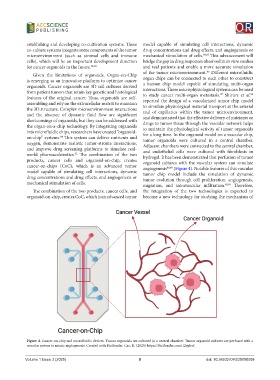
            cancer-on-chips (CoC), which is an advanced tumor   angiogenesis 88,89  (Figure 4). Notable features of this vascular
            model capable of simulating cell interactions, dynamic   tumor  chip  model  include  the  simulation  of  dynamic
            drug concentrations and drug effects, and angiogenesis or   tumor evolution through cell proliferation, angiogenesis,
            mechanical stimulation of cells.                  migration, and intravascular infiltration. 88,89  Therefore,
               The combination of the two products, cancer cells, and   the integration of the two technologies is expected to
            organoid-on-chip, creates CoC, which is an advanced tumor   become a new technology for studying the mechanism of


            Figure 4. Cancer-on-chip and microfluidic devices. Tumor organoids are cultured in a central chamber. Tumor organoid cultures are perfused with a
            vascular system to mimic angiogenesis. Created with BioRender. Cao, K. (2025) https://BioRender.com/12vphvf.


            Volume 1 Issue 2 (2025)                         9                            doi: 10.36922/OR025050008

