


Page 111 - OR-1-2
P. 111
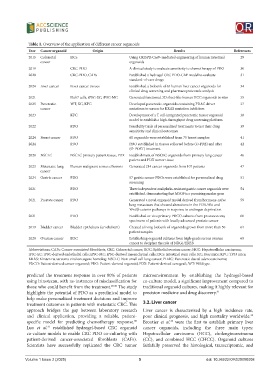
Table 1. Overview of the application of different cancer organoids
             Year  Cancer organoid      Origin                             Results                  References
             2015  Colorectal   ISCs                    Using CRISPR-Cas9–mediated engineering of human intestinal   29
                  cancer                                organoids
             2019              CRC-PDO                  A clinical study to evaluate sensitivity to chemotherapy of PDO  30
             2020              CRC-PDO, CAFs            Established a hydrogel CRC PDO-CAF model to evaluate   31
                                                        standard-of-care drugs
             2024  Liver cancer  Liver cancer tissues   Established a biobank of 65 human liver cancer organoids for   34
                                                        clinical drug screening and pharmacoproteomic analysis
             2021              Huh7 cells, iPSC-EC, iPSC-MC  Generated functional, 3D sheet-like human HCC organoids in vitro  35
             2025  Pancreatic   WT, KC, KPC             Developed pancreatic organoids containing PDAC driver   37
                  cancer                                mutations to screen for KRAS mutation inhibitors
             2023              KPC                      Development of a T cell-integrated pancreatic tumor organoid   38
                                                        model to establish a high-throughput drug screening platform
             2022              PDO                      Feasibility trials of personalized treatments to test their drug   39
                                                        sensitivity and clinical outcomes
             2024  Breast cancer  PDO                   60 organoids were established from 75 breast samples  41
             2024              PDO                      PDO established in tissues collected before (O-PRE) and after   42
                                                        (O-POST) treatment
             2020  NSCLC       NSCLC primary patient tissue, PDX  Establishment of NSCLC organoids from primary lung cancer   46
                                                        patient and PDX tumor tissue
             2023  Metastatic lung   Human malignant serous effusions  Generated 214 cancer organoids from 107 patients  47
                  cancer
             2024  Gastric cancer  PDO                  57 gastric cancer PDOs were established for personalized drug   51
                                                        screening
             2021              PDO                      Three independent oxaliplatin-resistant gastric cancer organoids were   54
                                                        established, demonstrating that MYOF is a promising marker gene
             2021  Prostate cancer  PDO                 Generated a novel organoid model derived from hormone-naïve   59
                                                        lung metastases that showed alterations in the PI3K/Akt and
                                                        Wnt/β-catenin pathways in response to androgen deprivation
             2021              PDO                      Established ex vivo primary PDCO cultures from prostatectomy   60
                                                        specimens of patients with locally advanced prostate cancer
             2019  Bladder cancer  Bladder epithelium (urothelium)  Created a living biobank of organoids grown from more than 50   64
                                                        patient samples
             2020  Ovarian cancer  EOC                  Establishing organoid cultures from high-grade serous ovarian   69
                                                        cancer to decipher the role of NRG1/ERBB
             Abbreviations: CAFs: Cancer-associated fibroblasts; CRC: Colorectal cancer; EOC: Epithelial ovarian cancer; HCC: Hepatocellular carcinoma;
             iPSC-EC: iPSC-derived endothelial cells; iPSC-MC: iPSC-derived mesenchymal cells; ISCs: Intestinal stem cells; KC: Kras mice; KPC: TP53 mice;
             KRAS: Kirsten rat sarcoma viral oncogene homolog; NSCLC: Non-small cell lung cancer; PDAC: Pancreatic ductal adenocarcinoma;
             PDCO: Patient-derived cancer organoid; PDO: Patient-derived organoid; PDX: Patient-derived xenograft; WT: Wildtype.

            predicted the treatment response in over 80% of patients   microenvironment by establishing the hydrogel-based
            using irinotecan, with no instances of misclassification for   co-culture model, a significant improvement compared to
            those who could benefit from the treatment. 28,30  The study   traditional organoid cultures, making it highly relevant for
            highlights the potential of PDO as a preclinical model to   precision medicine and drug discovery. 31
            help make personalized treatment decisions and improve
            treatment outcomes in patients with metastatic CRC. This   3.2. Liver cancer
            approach  bridges  the gap between laboratory research   Liver cancer is characterized by a high incidence rate,
            and clinical application, providing a reliable, patient-  poor clinical prognosis, and high mortality worldwide.
                                                                                                            32
            specific model for predicting chemotherapy response.    Broutier  et al.  were the first to establish primary liver
                                                          30
                                                                          33
            Luo  et al.  established hydrogel-based CRC organoid   cancer organoids, including the three main types:
                     31
            co-culture models to enable CRC PDO co-culturing with   Hepatocellular carcinoma (HCC), cholangiocarcinoma
            patient-derived cancer-associated fibroblasts (CAFs).   (CC), and combined HCC (CHCC). Organoid cultures
            Scientists have successfully replicated the CRC tumor   faithfully preserved the histological, transcriptomic, and

            Volume 1 Issue 2 (2025)                         5                            doi: 10.36922/OR025050008

