


Page 108 - OR-1-2
P. 108
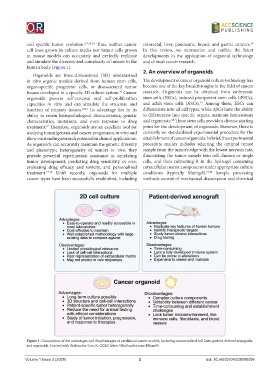
and specific tumor evolution. 6,7,12-14  Thus, neither cancer   colorectal, liver, pancreatic, breast, and gastric cancers.
                                                                                                            16
            cell lines grown in culture media nor tumor cells grown   In this review, we summarize and outline the latest
            in mouse models can accurately and perfectly replicate   developments in the application of organoid technology
            and simulate the diversity and complexity of tumors in the   and clinical cancer research.
            human body (Figure 1).
                                                              2. An overview of organoids
               Organoids are three-dimensional (3D) miniaturized
            in vitro  organic  models  derived  from  human  stem  cells,   The development of cancer organoid culture technology has
            organ-specific progenitor cells, or disassociated tumor   become one of the key breakthroughs in the field of cancer
            tissues developed in a specific 3D culture system.  Cancer   research. Organoids can be obtained from embryonic
                                                    15
            organoids possess self-renewal and self-proliferation   stem cells (ESCs), induced pluripotent stem cells (iPSCs),
                                                                                      19
            capacities  in vitro and can simulate the structure and   and adult  stem cells (ASCs).  Among  them, ESCs  can
            function of primary tissues. 15,16  Its advantage lies in its   differentiate into all cell types, while ASCs have the ability
            ability to retain histopathological characteristics, genetic   to differentiate into specific organs, maintain homeostasis
                                                                          20
            characteristics,  mutations,  and even  response to  drug   and regenerate.  These stem cells provide a diverse starting
            treatment.  Therefore, organoids are an excellent tool for   point for the development of organoids. However, there is
                     17
            studying tumorigenesis and cancer progression in vitro and   currently no standardized experimental procedure for the
            show outstanding research potential in clinical applications.   establishment of cancer organoids. In brief, the experimental
            As organoids can accurately maintain the genetic diversity   procedure mainly includes selecting the optimal tumor
            and phenotypic heterogeneity of tumors  in vivo, they   sample from the tumor’s edge with the lowest necrosis rate,
            provide  powerful  experimental  assistance  in  simulating   dissociating the tumor sample into cell clusters or single
            tumor development, predicting drug sensitivity  in vivo,   cells, and then cultivating it in the hydrogel containing
            evaluating drug efficacy and toxicity, and personalized   extracellular matrix components under appropriate culture
            treatment. 17,18  Until recently, organoids for multiple   conditions (typically Matrigel). 19,20  Sample processing
            cancer types have been successfully established, including   methods consist of mechanical dissociation and chemical


            Figure 1. Comparison of the advantages and disadvantages of preclinical cancer models, including immortalized cell lines, patient-derived xenografts,
            and organoids. Created with BioRender. Cao, K. (2025) https://BioRender.com/48hmj45.


            Volume 1 Issue 2 (2025)                         2                            doi: 10.36922/OR025050008

