


Page 123 - OR-1-2
P. 123
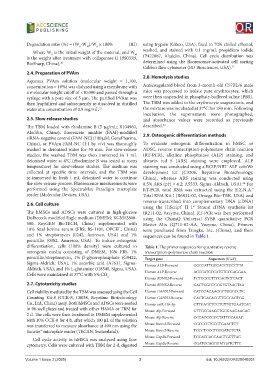
Degradation ratio (%) = (W -W )/W  × 100%   (III)  using trypsin (Gibco, USA), fixed in 70% chilled ethanol,
                                   0  N   0
               Where W  is the initial weight of the material, and W    washed, and stained with 0.1  mg/mL propidium iodide
                       0
                                                          N
            is the weight after treatment with collagenase II (BS033B,   (P422887, Aladdin, China). Cell cycle distribution was
            BioSharp, China). 20                              determined  using  the  fluorescence-activated  cell  sorting
                                                              Calibur flow cytometer (BD Biosciences, USA). 22
            2.4. Preparation of PVAm
                                                              2.8. Hemolysis studies
            Aqueous  PVAm  solution  (molecular weight =  1,100,
            concentration = 10%) was dialyzed using a membrane with   Anticoagulated blood from 3-month-old C57BL/6 male
            a molecular weight cutoff of <10,000 and passed through a   mice was processed to isolate pure erythrocytes, which
            syringe with a pore size of 5 μm. The purified PVAm was   were then suspended in phosphate-buffered saline (PBS).
            then lyophilized and subsequently re-dissolved in distilled   The TBM was added to the erythrocyte suspensions, and
            water at a concentration of 0.9 mg/mL. 21         the mixture was incubated at 37°C for 180 min. Following
                                                              incubation, the  supernatants  were photographed,
            2.5. Slow-release studies                         and absorbance values were recorded as previously
            The TBM loaded with rhodamine B (5 μg/mL; R104960,   described. 23
            Aladdin, China), fluorescein amidite (FAM)-modified   2.9. Osteogenic differentiation methods
            siRNA-negative control (FAM-NC) (100 μM; GenePharma,
            China), or  PVAm-FAM-NC (1:1 by v/v)  was thoroughly   To  evaluate  osteogenic  differentiation in  hMSC or
            washed  in  deionized  water  for  30  min.  For slow-release   ADSC, reverse transcription-polymerase chain reaction
            studies, the washed TBM was then immersed in 1  mL   (RT-PCR), alkaline phosphatase (ALP) staining, and
            deionized water at 4°C (rhodamine B was tested at room   alizarin red S (ARS) staining were employed. ALP
            temperature) for slow-release studies. The medium was   staining was conducted using a BCIP/NBT ALP coloWr
            collected at specific time intervals, and the TBM was   development kit (C3206, Beyotime Biotechnology,
            re-immersed  in fresh 1  mL  deionized  water  to continue   China), whereas ARS staining was conducted using
            the slow-release process. Fluorescence measurements were   0.5% ARS (pH = 4.2; A5533, Sigma-Aldrich, USA).  For
                                                                                                        24
            performed using the SpectraMax Paradigm microplate   RT-PCR, total RNA was extracted using the E.Z.N.A.   ®
            reader (Molecular Devices, USA).                  Total RNA Kit I (R6834-02, Omega Bio-TEK, USA) and
                                                              reverse-transcribed into complementary DNA (cDNA)
            2.6. Cell culture
                                                                                   st
                                                                              ®
                                                              using  the  HiScript   II  1   Strand  cDNA  synthesis kit
            The  hMSCs  and  ADSCs  were  cultured  in  high-glucose   (R211-02, Vazyme, China). RT-PCR was then performed
            Dulbecco’s modified Eagle medium (DMEM; KGM12800-  using the ChamQ Universal SYBR quantitative PCR
            500, KeyGEN BioTECH, China) supplemented with     Master Mix (Q711-02-AA, Vazyme, China). Primers
            10% fetal bovine serum (FBS; BS-1101, OPCEL, China)   were purchased from Tsingke, Inc. (China), and their
            and 1% streptomycin (0242, Amresco, USA) and 1%   sequences can be found in Table 1.
            penicillin (0382, Amresco, USA). To induce osteogenic
            differentiation, cells (100% density) were cultured in   Table 1. The primer sequences for quantitative reverse
            osteogenic media consisting of DMEM, 10% FBS, 1%   transcription-polymerase chain reaction
            penicillin/streptomycin,  1%  β-glycerophosphate  (G9422,   Target gene       Sequences (5’→3’)
            Sigma-Aldrich, USA), 1% ascorbic acid (A7631, Sigma-  Human ALP-Forward  GGCCATTGGCACCTGCCTTA
            Aldrich, USA), and 1% L-glutamine (G8540, Sigma, USA).
            Cells were maintained at 37°C with 5% CO .         Human ALP-Reverse   ACCCATCCCATCTCCCAGGAA
                                               2               Human RUNX2-Forward  TCTGGCCTTCCACTCTCAGT
            2.7. Cytotoxicity studies                          Human RUNX2-Reverse  GACTGGCGGGGTGTAAGTAA
            Cell viability mediated by the TBM was assessed using the Cell   Human GAPDH-Forward  CATGGAGAAGGCTGGGGCTC
            Counting  Kit-8  (CCK-8;  C0038,  Beyotime  Biotechnology   Human GAPDH-Reverse  CACTGACACGTTGGCAGTGG
            Co., Ltd., China) assay. Both hMSCs and ADSCs were seeded   Human miR-138-5p  CTTGAGCTGGTGTTGTGAATCAG
            in 96-well plates and treated with either HAMA or TBM for   Mouse Alp-Forward  GTTGCCAAGCTGGGAAGAACAC
            2 d. The cells were then incubated in DMEM supplemented   Mouse Alp-Reverse  CCCACCCCGCTATTCCAAAC
            with 10% CCK-8 for 4 h, after which 100 μL of the solution
            was transferred to measure absorbance at 490 nm using the   Mouse Run×2-Forward  CGCCCCTCCCTGAACTCT
            Sunrise™ microplate reader (TECAN, Switzerland).   Mouse Run×2-Reverse  TGCCTGCCTGGGATCTGTA
               Cell cycle activity in hMSCs was analyzed using flow   Mouse Gapdh-Forward  TGCACCACCAACTGCTTAG
            cytometry. Cells were cultured with TBM for 2 d, digested   Mouse Gapdh-Reverse  GGATGCAGGGATGATGTTC


            Volume 1 Issue 2 (2025)                         3                            doi: 10.36922/OR025040003

