


Page 24 - OR-1-2
P. 24
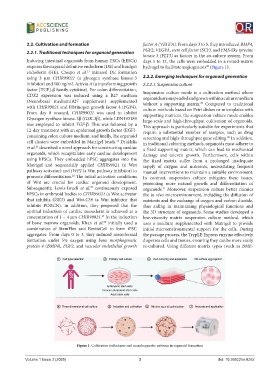
2.2. Cultivation and formation                    factor A (VEGFA). From days 3 to 5, they introduced BMP4,
                                                              FGF2, VEGFA, stem cell factor (SCF), and FMS-like tyrosine
            2.2.1. Traditional techniques for organoid generation
                                                              kinase 3 (FLT3) as factors in the co-culture system. From
            Inducing intestinal organoids from human ESCs (hESCs)   days 5 to 12, the cells were embedded in a mixed-matrix
            requires the stages of definitive endoderm (DE) and hindgut   hydrogel to facilitate angiogenesis  (Figure 1).
                                                                                         28
            endoderm (HE). Crespo  et al.  initiated DE formation
                                      13
            using 3  μm  CHIR99021 (a glycogen synthase kinase-3   2.2.2. Emerging techniques for organoid generation
            inhibitor) and 100 ng/mL Activin A (a transforming growth   2.2.2.1. Suspension culture
            factor [TGF]-β family cytokine). For colon differentiation,   Suspension culture mode is a cultivation method where
            CDX2 expression was induced using a B27 medium    organoids are suspended and grown within a culture medium
            (Neurobasal medium/B27 supplement) supplemented   without  a  supporting  matrix.   Compared  to  traditional
                                                                                      29
            with CHIR99021 and Fibrinogen growth factor 4 (FGF4).   culture methods based on Petri dishes or microplates with
            From day 8 onward,  CHIR99021 was used to inhibit   supporting matrices, the suspension culture mode enables
            Glycogen synthase kinase-3β (GSK-3β), while LDN193189   large-scale and high-throughput cultivation of organoids.
            was employed to inhibit  TGF-β. This was followed by a   This approach is particularly suitable for experiments that
            12-day treatment with an epidermal growth factor (EGF)-  require a substantial number of samples, such as drug
            containing colon culture medium, and finally, the organoid   screening and high-throughput gene editing.  In addition,
                                                                                                  30
            cell clusters were embedded in Matrigel beads.  Drakhlis   in traditional culturing methods, organoids must adhere to
                                                   13
            et al.  described a novel approach for constructing cardiac   a fixed supporting matrix, which can lead to mechanical
                26
            organoids, which recapitulates early cardiac development   damage and uneven growth. Furthermore, cells within
            using hPSCs. They embedded hPSC aggregates into the   the  fixed  matrix  suffer  from  a  prolonged  inadequate
            Matrigel and sequentially applied  CHIR99021 (a Wnt   supply of oxygen and nutrients, necessitating frequent
            pathway activator) and IWP2 (a Wnt pathway inhibitor) to   manual interventions to maintain a suitable environment.
            promote differentiation.  The initial activation conditions   In contrast, suspension culture mitigates these issues,
                                26
            of Wnt are crucial for cardiac organoid development.   promoting more natural growth and differentiation of
            Subsequently, Lewis-Israeli  et al.  continuously exposed   organoids.   Moreover,  suspension  culture  better  mimics
                                       27
                                                                      31
            hPSCs in embryoid bodies to CHIR99021 (a Wnt activator   the in vivo microenvironment, including the diffusion of
            that inhibits  GSK3) and  Wnt-C59 (a Wnt inhibitor that   nutrients and the exchange of oxygen and carbon dioxide,
            inhibits  PORCN).  In  addition,  they  proposed  that  the   thus aiding in maintaining physiological functions and
            optimal  induction of  cardiac  mesoderm  is  achieved at  a   the 3D structure of organoids. Some studies developed a
            concentration of 1 – 4 μm CHIR99021.  In the induction   low-viscosity  matrix  suspension  culture  method,  which
                                            27
            of bone marrow organoids, Khan  et al.  initially used a   uses a medium supplemented with Matrigel to provide
                                             28
            combination of StemFlex and RevitaCell to form iPSC   initial microenvironmental  support  for the  cells. During
            aggregates. From days 0 to 3, they induced mesodermal   the passage process, the TrypLE Express enzyme effectively
            formation  under  5%  oxygen  using  bone morphogenetic   disperses cells and tissues, ensuring they can be more easily
            protein 4 (BMP4), FGF2, and vascular endothelial growth   re-cultured. Using different matrix  types (such as  BME-


                                  Figure 1. Cultivation techniques and morphogenetic patterns in organoid formation


            Volume 1 Issue 2 (2025)                         3                                 doi: 10.36922/or.8262

