


Page 27 - OR-1-2
P. 27
approximately 25  kDa. In the body, TGF-β exists in an   and between cells and the matrix, promoting cell growth,
            inactive pre-cursor form, consisting of a secreted pre-cursor   differentiation, and functional expression. 60,61  In contrast,
            protein complex with latent TGF-β-binding proteins. The   synthetic matrix hydrogels are chemically synthesized,
            protein is activated through enzymatic cleavage or other   allowing for high tunability and precise control over their
            activation mechanisms when required by cells, producing   composition, mechanical properties, and degradation
            biologically active TGF-β.  In a humanized skin organoid   characteristics. In addition, synthetic matrices can be
                                 55
            model, aggregating hPSCs into multicellular clusters, the   chemically modified or functionalized to precisely regulate
            addition of a matrix, BMPs, and LSB (a TGF-β inhibitor)   cell behavior and organoid development. 62
            in the culture dish inhibits TGF-β signaling and facilitates   3.1. Components of natural hydrogels
            ectoderm induction from pluripotent stem cells, leading to
            the formation of initial epithelial cysts.  Similarly, in the   3.1.1. Decellularized ECM (dECM)
                                            56
            formation of expanded neuroepithelium organoids (ENOs),   The ECM is a complex network secreted by cells,
            a gradient of decreasing TGF-β concentrations is employed.   primarily composed of proteins, glycosaminoglycans
            Adding LSB during cortical neural induction suppresses   (GAGs), and bioactive factors, such as TGF-β1 and FGF.
            TGF-β signaling, resulting in organoid morphology closely   It plays a crucial role in the cellular microenvironment,
            resembling cortical organoids. In contrast, organoids not   contributing to cell survival and modulating cellular
            treated with TGF-β inhibitors exhibit morphology similar   behavior.  ECM provides physical support to cells
                                                                     63
            to ENOs. Thus, generating ENOs from different hESC/iPSC   and conveys biological information while facilitating
            lines is associated with varying levels of TGF-β inhibition.    intercellular signaling. By decellularizing ECM to create
                                                          57
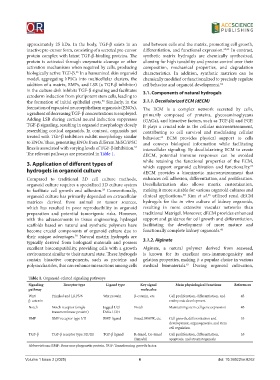
            The relevant pathways are presented in Table 1.   dECM, potential immune responses can be avoided
            3. Application of different types of              while retaining the functional properties of the ECM,
                                                              which support organoid cultivation and functionality.
                                                                                                            64
            hydrogels in organoid culture                     dECM provides a biomimetic microenvironment that
            Compared to traditional 2D cell culture methods,   enhances cell adhesion, differentiation, and proliferation.
            organoid culture requires a specialized 3D culture system   Decellularization also allows matrix customization,
            to facilitate cell growth and adhesion.  Conventionally,   making it more suitable for various organoid cultures and
                                             58
                                                                                         66
                                                                               65
            organoid culture has primarily depended on extracellular   clinical applications.  Kim  et al.  utilized renal dECM
            matrices  derived from animal  or tumor  sources,   hydrogels for the  in  vitro culture of kidney organoids,
            which has resulted in poor reproducibility in organoid   resulting in more extensive vascular networks than
            preparation  and  potential  tumorigenic  risks.  However,   traditional Matrigel. Moreover, dECM provides enhanced
            with the advancements in tissue engineering, hydrogel   support and guidance for cell growth and differentiation,
            scaffolds  based  on  natural  and  synthetic  polymers  have   facilitating the development of more mature and
            become crucial components of organoid culture due to   functionally complete kidney organoids. 66
            their unique advantages.  Natural matrix hydrogels are
                                 59
            typically derived from biological materials and possess   3.1.2. Alginate
            excellent biocompatibility, providing cells with a growth   Alginate, a natural polymer derived from seaweed,
            environment similar to their natural state. These hydrogels   is known for its excellent non-immunogenicity and
            contain bioactive components, such as proteins and   gelation properties, making it a popular choice in various
                                                                                67
            polysaccharides, that can enhance interactions among cells   medical biomaterials.  During organoid cultivation,
             Table 1. Organoid-related signaling pathways
             Signaling      Receptor type     Ligand type    Key signal     Main physiological functions  References
             pathway                                         molecules
             Wnt/      Frizzled and LRP5/6   Wnt protein  β-catenin, etc.  Cell proliferation, differentiation, and   43
             β-catenin                                                   embryonic development
             Notch     Notch receptor (single   Jagged 1/2/  Notch       Maintaining stem cell gene expression  48
                       transmembrane protein)  Delta 1/3/4
             BMP       BMP receptor type I/II  BMP ligand  Smad, MAPK, etc.  Cell growth, differentiation and   53
                                                                         development, organogenesis, and stem
                                                                         cell regulation
             TGF-β     TGF-β receptor type I/II/III  TGF-β ligand  R-Smad, Co-Smad   Cell proliferation, differentiation,   55
                                                          (Smad4)        apoptosis, and stromatogenesis
             Abbreviations: BMP: Bone morphogenetic protein, TGF: Transforming growth factor.


            Volume 1 Issue 2 (2025)                         6                                 doi: 10.36922/or.8262

