


Page 30 - OR-1-2
P. 30
70 – 85% of its volume but only 25 – 35% of its total cells.    were encapsulated within a microfibrous structure created
                                                          88
            The remaining 65 – 75% consists of non-cardiomyocytes,   by bioprinting, leading to a continuous endothelial layer
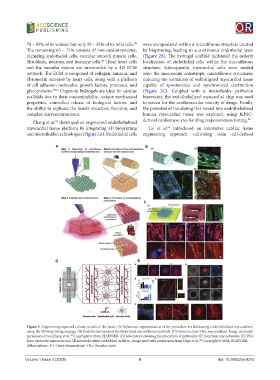
            including endothelial cells, vascular smooth muscle cells,   (Figure  2B). The hydrogel scaffold facilitated the orderly
            fibroblasts, neurons, and immune cells.  These heart cells   localization of endothelial cells within the microfibrous
                                            89
            and the vascular system are surrounded by a 3D ECM   structure. Subsequently, myocardial cells were seeded
            network. The ECM is composed of collagen, laminin, and   onto the macroscale anisotropic microfibrous structures,
            fibronectin secreted by heart cells, along with a plethora   inducing the formation of well-aligned myocardial tissue
            of cell adhesion molecules, growth factors, proteases, and   capable of spontaneous and synchronized contraction
            glycoproteins. 90,91  Organoid hydrogels are ideal for cardiac   (Figure  2C). Coupled with a microfluidic perfusion
            scaffolds due to their customizability, unique mechanical   bioreactor, the endothelialized myocardial chip was used
            properties, controlled release of biological factors, and   to screen for the cardiovascular toxicity of drugs. Finally,
            the ability to replicate the heart’s structure, function, and   the potential of translating this model into endothelialized
            complex microenvironment.                         human myocardial tissue was explored, using hiPSC-
               Zhang et al.  developed an engineered endothelialized   derived cardiomyocytes for drug responsiveness testing. 92
                         92
            myocardial tissue platform by integrating 3D bioprinting   Lu  et al.  introduced an innovative cardiac tissue
                                                                        93
            and microfluidic technologies (Figure 2A). Endothelial cells   engineering approach cultivating stem cell-derived
                         A                                     B


                                                              C


                         D                                  E


            Figure 2. Engineering organoid culture models of the heart. (A) Schematic representation of the procedure for fabricating endothelialized myocardium
            using the 3D bioprinting strategy. (B) Endothelialization of the bioprinted microfibrous scaffolds. (C) Construction of the myocardium. Image used with
            permission from Zhang et al.,  Copyright © 2016, ELSEVIER. (D) Schematics showing the procedure of perfusable 3D microvascular networks. (E) VUs
                               92
            form extensive microvascular 3D networks when embedded in fibrin. Image used with permission from Orge et al.,  Copyright © 2024, ELSEVIER.
                                                                                      98
            Abbreviations: 3D: Three-dimensional; VUs: Vascular units.
            Volume 1 Issue 2 (2025)                         9                                 doi: 10.36922/or.8262

