


Page 32 - OR-1-2
P. 32
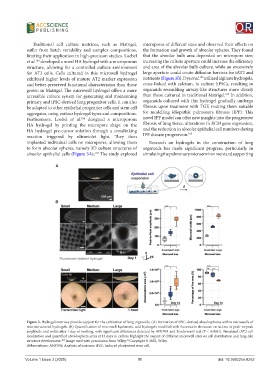
Traditional cell culture matrices, such as Matrigel,   micropores of different sizes and observed their effects on
            suffer from batch variability and complex compositions,   the formation and growth of alveolar spheres. They found
            limiting their application in high-precision studies. Loebel   that  the  alveolar  bulb area  depended on  micropore  size;
            et al.  developed a novel HA hydrogel with a microporous   increasing the culture aperture could increase the efficiency
                104
            structure, allowing for a controlled culture environment   and area of the alveolar bulb culture, while an excessively
            for AT2  cells. Cells cultured in this microwell hydrogel   large aperture could create diffusion barriers for iAT2 and
                                                                                      105
            exhibited higher levels of mature AT2 marker expression   nutrients (Figure 3B). Dye et al.  utilized alginate hydrogels,
            and better-preserved functional characteristics than those   cross-linked with calcium, to culture hPSCs, resulting in
            grown in Matrigel. The microwell hydrogel offers a more   organoids resembling airway-like structures more closely
                                                                                                 105
            accessible culture system for generating and maintaining   than those cultured in traditional Matrigel.  In addition,
            primary and iPSC-derived lung progenitor cells. It can also   organoids cultured with this hydrogel gradually undergo
            be adapted to other epithelial progenitor cells and stem cell   fibrosis upon treatment with TGF, making them suitable
            aggregates, using various hydrogel types and compositions.   for modelling idiopathic pulmonary fibrosis (IPF). This
            Furthermore, Loebel  et al.  designed a microporous   novel IPF model can offer new insights into the progressive
                                    104
            HA hydrogel by printing the micropore shape on the   fibrosis of lung tissue, alterations in ECM gene expression,
            HA hydrogel pre-cursor solution through a crosslinking   and the reduction in alveolar epithelial cell numbers during
            reaction triggered by ultraviolet light. They then   IPF disease progression. 105
            implanted individual cells on micropores, allowing them   Research on hydrogels in the construction of lung
            to form alveolar spheres, namely 3D culture structures of   organoids has made significant progress, particularly in
            alveolar epithelial cells (Figure 3A).  The study explored   simulating the pulmonary microenvironment and supporting
                                         104
                         A


                         B


            Figure 3. Hydrogel matrices provide support for the cultivation of lung organoids. (A) Formation of iPSC-derived alveolospheres within microwells of
            microstructured hydrogels. (B) Quantification of microwell hyaluronic acid hydrogels modified with fluorescein showcase variations in peak-to-peak
            amplitude and width after 1 day of swelling, with significant differences detected by ANOVA and Bonferroni’s test (P < 0.0001). Simulated iAT2 cell
            localization and quantified alveolosphere areas at 14 days in culture highlight the impact of different microwell sizes on cell distribution and lung-like
            structure development.  Image used with permission from Wiley,  Copyright © 2022, Wiley.
                                                       24
                           104
            Abbreviations: ANOVA: Analysis of variance; iPSC: Induced pluripotent stem cell.
            Volume 1 Issue 2 (2025)                         11                                doi: 10.36922/or.8262

