


Page 35 - OR-1-2
P. 35
the primary challenges in engineering kidney organoids   hydrogels. Compared with traditional alginate hydrogels
            are safety, immaturity, and limited vascularization.  There   used for kidney organoid culture, the calcium ion-cross-
                                                     121
            is no available method to generate kidney organoids that   linked alginate employed in their study has significantly
            fully recapitulate the complex structure and function of the   higher viscoelasticity, resembling murine embryonic
            kidney, limiting their efficacy in modeling kidney diseases   kidneys more closely. The use of alginate hydrogels as a
            and regenerative medicine. 66                     culture matrix significantly impacts nephron morphology
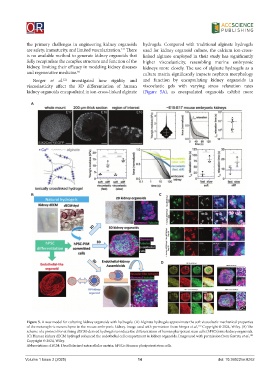
               Nerger  et al.  investigated how rigidity and   and function by encapsulating kidney organoids in
                            122
            viscoelasticity affect the 3D differentiation of human   viscoelastic gels with varying stress relaxation rates
            kidney organoids encapsulated in ion-cross-linked alginate   (Figure  5A), as encapsulated organoids exhibit more

              A


              B                                                      C


                                                                     D


            Figure 5. A new model for culturing kidney organoids with hydrogels. (A) Alginate hydrogels approximate the soft viscoelastic mechanical properties
            of the metanephric mesenchyme in the mouse embryonic kidney. Image used with permission from Nerger et al.,  Copyright © 2024, Wiley. (B) The
                                                                                     122
            scheme of a protocol for utilizing dECM-derived hydrogels to induce the differentiation of human pluripotent stem cells (hPSCs) into kidney organoids.
            (C) Human kidney dECM hydrogel enhanced the endothelial cell compartment in kidney organoids. Image used with permission from Garreta et al.,
                                                                                                           123
            Copyright © 2024, Wiley.
            Abbreviations: dECM: Decellularized extracellular matrix; hPSCs: Human pluripotent stem cells.

            Volume 1 Issue 2 (2025)                         14                                doi: 10.36922/or.8262

