


Page 61 - OR-1-3
P. 61
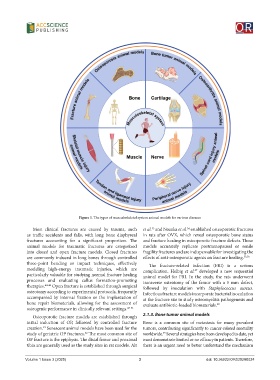
Figure 1. The types of musculoskeletal system animal models for various diseases

               Most clinical fractures are caused by trauma, such   et al.  and Nozaka et al.  established osteoporotic fractures
                                                                  53
                                                                                 54
            as traffic accidents and falls, with long bone diaphyseal   in rats after OVX, which reveal osteoporotic bone status
            fractures accounting for a significant proportion. The   and fracture healing in osteoporotic fracture defects. These
            animal  models  for traumatic fractures  are  categorized   models accurately replicate postmenopausal or senile
            into closed and open fracture models. Closed fractures   fragility fractures and are indispensable for investigating the
            are commonly induced in long bones through controlled   effects of anti-osteoporotic agents on fracture healing. 55,56
            three-point  bending  or  impact  techniques,  effectively   The fracture-related infection (FRI) is a serious
            modeling  high-energy  traumatic  injuries,  which  are   complication. Helbig  et al.  developed a new sequential
                                                                                    57
            particularly valuable for studying normal fracture healing   animal model for FRI. In the study, the rats underwent
            processes and evaluating callus formation-promoting   transverse osteotomy of the femur with a 5  mm defect,
            therapies. 44-46  Open fracture is established through surgical   followed by inoculation with  Staphylococcus aureus.
            osteotomy according to experimental protocols, frequently   Infectious fracture models incorporate bacterial inoculation
            accompanied by internal fixation or the implantation of   at the fracture site to study osteomyelitis pathogenesis and
            bone repair biomaterials, allowing for the assessment of   evaluate antibiotic-loaded biomaterials. 58
            osteogenic performance in clinically relevant settings. 47-51
               Osteoporotic fracture models are established through   2.1.3. Bone tumor animal models
            initial induction of OP, followed by controlled fracture   Bone is a common site of metastasis for many prevalent
            creation.  Senescent animal models have been used for the   tumors, contributing significantly to cancer-related mortality
                   43
            study of geriatric OP fractures.  The most common site of   worldwide.  Several strategies have been developed to date, yet
                                                                      59
                                     52
            OP fracture is the epiphysis. The distal femur and proximal   most demonstrate limited or no efficacy in patients. Therefore,
            tibia are generally used as the study sites in rat models. Alt   there is an urgent need to better understand the mechanism

            Volume 1 Issue 3 (2025)                         3                            doi: 10.36922/OR025280024

