


Page 8 - OR-1-3
P. 8
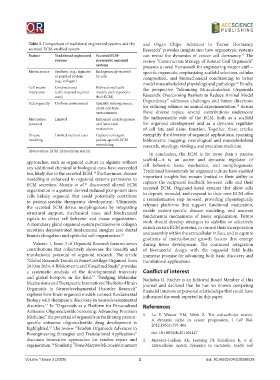
Table 1. Comparison of traditional engineered systems and the   and  Organ  Chips:  Advances  in Tumor  Dormancy
             secreted ECM-enabled system                      Research” provides insights into how organotypic systems
             Feature    Traditional engineered   Secreted ECM–  can reveal the dynamics of cancer cell dormancy.  The
                                                                                                        17
                        systems           permissive organoid   review “Construction Strategy of Rotator Cuff Organoids”
                                          systems             presents a novel framework for engineering rotator cuff—
             Matrix source  Synthetic (e.g., alginate)   Endogenously secreted   specific organoids, emphasizing scaffold selection, cellular
                        or purified protein   by cells        composition, and biomechanical conditioning to better
                        (e.g., collagen)                      model musculoskeletal physiology and pathology.  Finally,
                                                                                                     18
             Cell-matrix   Unidirectional   Bidirectional (cells   the perspective “Advancing Musculoskeletal Organoids
             interaction  (cells respond to preset   modify and respond to
                        cues)             their ECM)          Research: Overcoming Barriers to Reduce Animal Model
             Heterogeneity  Uniform environment  Spatially heterogeneous,   Dependency”  addresses  challenges  and  future  directions
                                                                                                      19
                                          multi-cell-type     for reducing reliance on animal experimentation.  Across
                                          environments        these diverse topics, several contributions underscore
             Maturation   Limited         Enhanced morphogenesis   the indispensable role of the ECM, both as a scaffold
             potential                    and functional      for organoid development and as a dynamic regulator
                                          maturation          of cell fate and tissue function. Together, these articles
             Disease    Limited to preset cues  Captures emergent   exemplify the diversity of organoid applications, spanning
             modeling                     patient-specific ECM   bibliometric mapping, neurological and musculoskeletal
                                          remodeling          research, oncology, virology, and precision medicine.
             Abbreviation: ECM: Extracellular matrix.
                                                                In conclusion, the ECM is far more than a passive
                                                              scaffold—it is an active and dynamic regulator of
            approaches, such as organoid culture in alginate without
            any additional chemical or biological cues, have succeeded   cell behavior, tissue mechanics, and morphogenesis.
            too, likely due to the secreted ECM.  Furthermore, disease   Traditional biomaterials for organoid culture have enabled
                                         10
            modeling is enhanced in organoid systems permissive to   important insights but remain limited in their ability to
            ECM  secretion.  Morais  et al.   discovered  altered  ECM   capture the reciprocal feedback between cells and their
                                     11
            organization in a patient-derived induced pluripotent stem   secreted ECM. Organoid-based systems that allow cells
            cells kidney organoid that could potentially contribute   to deposit, remodel, and respond to their own ECM offer
            to patient-specific therapeutic development. Ultimately,   a transformative step forward, providing physiologically
            the secreted ECM drives morphogenesis by integrating   relevant platforms that support functional maturation,
            structural  support,  mechanical  cues,  and  biochemical   enable patient-specific disease modeling, and uncover
            signals to direct cell behavior and tissue organization.   fundamental mechanisms of tissue organization. Future
            A mammary gland organoid system permissive to collagen   work should develop strategies to stabilize or selectively
            secretion demonstrated fundamental insights into ductal   enrich certain ECM proteins, to control their incorporation
            branch elongation and epithelial self-organization. 12  and assembly within the extracellular milieu, and to capture
                                                              gradients of matrix-bound growth factors that emerge
               Volume 1, Issue 3 of Organoid Research features seven   during tissue development. The continued integration
            contributions that collectively showcase the breadth and   of biomaterial design with the organoid field holds
            translational potential of organoid research. The article   immense promise for advancing both basic discovery and
            “Global Research Trends in Bone/Cartilage Organoid from   translational applications.
            2010 to 2024: A Bibliometric and Visualized Study” provides
            a  systematic  analysis of  the  developmental  trajectory  Conflict of interest
            and global hotspots in the field.  “Bridging Molecular   Nicholas G. Fischer is an Editorial Board Member of this
                                        13
            Mechanisms and Therapeutic Innovations: The Role of Brain   journal and declared that he has no known competing
            Organoids  in Neurodevelopmental  Disorder Research”   financial interests or personal relationships that could have
            explores how brain organoid models connect fundamental   influenced the work reported in this paper.
            biology with therapeutic discovery in neurodevelopmental
            disorders.  In “Organoids as a Platform for Personalized   References
                    14
            Antisense Oligonucleotide Screening: Advancing Precision
            Medicine,” the potential of organoids in facilitating patient-  1.   Lu P, Weaver  VM, Werb Z. The  extracellular matrix:
                                                                 A  dynamic niche in cancer progression.  J  Cell Biol.
            specific antisense oligonucleotide drug development is   2012;196(4):395-406.
            highlighted.  The review “Tendon Organoids Advances in
                      15
            Bioengineering Strategies and Translational Applications”      doi: 10.1083/jcb.201102147
            discusses  innovative approaches for  tendon  repair  and   2.   Mayorca-Guiliani AE, Leeming DJ, Henriksen K,  et al.
            regeneration.  Similarly, “Bone Marrow Microenvironment   Extracellular matrix dynamics in metabolic health and
                       16

            Volume 1 Issue 3 (2025)                         2                            doi: 10.36922/OR025360028

