


Page 28 - TD-2-2
P. 28
Tumor Discovery                                                       A comprehensive review of bexarotene


            peroxisome proliferator-activated receptors (PPARs), and   (C max ) and the area under the plasma concentration-time
            thyroid hormone receptor (TR), ultimately leading to   curve (AUC) escalated with an increase in the dose .
                                                                                                        [9]
            transcriptional changes in the tumor cell .
                                            [4]
              Bexarotene exerts its biological effects through selective   3. Mechanism of action
            binding and activation of RXR subtypes, including RXRα,   Bexarotene acts as an agonist for RXRs, specifically RXRα,
            RXRβ, and RXRγ . Unlike other synthetic retinoids,   RXRβ, and RXRγ. RXRs are nuclear receptors that form
                           [5]
            bexarotene has demonstrated effectiveness at all stages   heterodimers with other nuclear receptors, such as RARs
            of CTCL. In this article, we have articulated the utility of   and TRs. Activation of RXRs by bexarotene can lead to
            bexarotene in treating multiform disease, its formulation   changes in gene expression, resulting in anti-tumor effects.
            development, various patents, and the need for future   Bexarotene also interacts with PPARs, specifically PPARγ.
            research to explore its clinical potential in treating   PPARs are transcription factors that regulate various cellular
            aggressive carcinomas.                             processes, including lipid metabolism, inflammation, and
                                                               cell proliferation. Activation of PPARγ by bexarotene has
            2. Hurdles in the formulation development          been implicated in the inhibition of tumor growth and
            of bexarotene                                      differentiation of cancer cells. Bexarotene can interact with
                                                               RARs, which are nuclear receptors that bind retinoic acid.
            Bexarotene is a solid, fine white powder with a molar mass   However, the affinity of bexarotene for RARs is relatively
            of 348.478  g/mol and the chemical formula C H O .   low compared to its affinity for RXRs. The exact role of
                                                    24
                                                         2
                                                       28
            Chemically, it is known as 4-(1-(5,6,7,8-tetrahydro-3,5,5,8,8-  RAR interaction in the therapeutic effects of bexarotene
            pentamethyl-2-naphthalen-yl)ethenyl) benzoic acid. The   is not fully understood. Bexarotene has been shown to
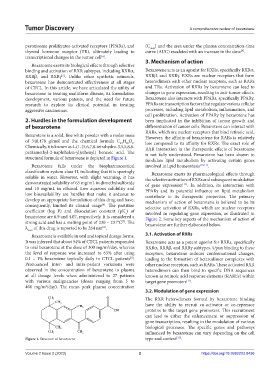
            structural formula of bexarotene is depicted in Figure 1.  modulate lipid metabolism by activating certain genes
              Bexarotene falls under the biopharmaceutical     involved in lipid homeostasis [10,11] .
            classification system class-ІІ, indicating that it is sparingly   Bexarotene exerts its pharmacological effects through
            soluble in water. However, with slight warming, it has   the selective activation of RXRs and subsequent modulation
            demonstrated solubility of 65 mg/mL in dimethylsulfoxide   of gene expression . In addition, its interaction with
                                                                               [11]
            and 10  mg/mL in ethanol. Low aqueous solubility and   PPARγ and its potential influence on lipid metabolism
            low bioavailability are hurdles that make it arduous to   contribute to its therapeutic properties. The primary
            develop an appropriate formulation of this drug and have,   mechanism of action of bexarotene is believed to be its
            consequently, limited  its clinical  usage . The partition   selective activation of RXRs, which are nuclear receptors
                                            [6]
            coefficient (log P) and dissociation constant (pK ) of   involved in regulating gene expression, as illustrated in
                                                      a
            bexarotene are 6.9 and 4.07, respectively. It is considered a   Figure 2. Some key aspects of the mechanism of action of
            strong acid and has a melting point of 230 – 231°C . The   bexarotene are further elaborated below.
                                                     [7]
            λ max  of this drug is reported to be 264 nm .
                                             [8]
              Bexarotene is available in oral and topical dosage forms.   3.1. Activation of RXRs
            It was inferred that about 54% of CTCL patients responded   Bexarotene acts as a potent agonist for RXRs, specifically
            to oral bexarotene at the dose of 300 mg/m /day, whereas   RXRα, RXRβ, and RXRγ subtypes. Upon binding to these
                                               2
            the level of response was increased to 63% after using   receptors, bexarotene induces conformational changes,
            0.1 – 1% bexarotene topically daily in CTCL patients .   leading to the formation of heterodimer complexes with
                                                        [3]
            Pronounced inter-  and intra-patient variations were   other nuclear receptors, such as RARs. These activated RXR
            observed in the concentration of bexarotene in plasma   heterodimers can then bind to specific DNA sequences
            at all dosage levels when administered to 27  patients   known as retinoic acid response elements (RAREs) within
            with  various  malignancies  (doses  ranging  from  5  to   target gene promoters .
                                                                                [11]
            400  mg/m /day). The mean peak plasma concentration
                    2
                                                               3.2. Modulation of gene expression
                                                               The RXR heterodimers  formed  by bexarotene binding
                                                               have  the  ability  to  recruit  co-activator  or  co-repressor
                                                               proteins to the target gene promoters. This recruitment
                                                               can lead to either the enhancement or suppression of
                                                               gene transcription, resulting in the modulation of various
                                                               biological processes. The specific genes and pathways
                                                               influenced by bexarotene can vary depending on the cell
                                                                            [11]
            Figure 1. Structure of bexarotene.                 type and context .

            Volume 2 Issue 2 (2023)                         2                          https://doi.org/10.36922/td.0436

