


Page 49 - TD-2-2
P. 49
Tumor Discovery                                                   Choroid plexus tumors: Benign to malignant


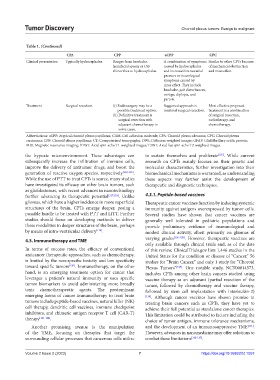
            Table 1. (Continued)
                             CPA                 CPP                   aCPP               CPC
            Clinical presentation  Typically hydrocephalus.  Ranges from headache,   A combination of symptoms  Similar to other CPTs because
                                                 hemifacial spasm or CSF   caused by hydrocephalus   of mechanical obstruction
                                                 rhinorrhea to hydrocephalus.  and increased intracranial   and mass effect.
                                                                       pressure or neurological
                                                                       symptoms caused by
                                                                       mass effect. They include
                                                                       headache, gait disturbances,
                                                                       vertigo, diplopia, and
                                                                       paresis.
            Treatment        Surgical resection.  (i)  Radiosurgery may be a   Suggested approach is   Most effective proposed
                                                   possible treatment option.  maximal surgical resection. treatment is a combination
                                                 (ii)  Definitive treatment is            of surgical resection,
                                                   surgical resection with                radiotherapy, and
                                                   adjuvant chemotherapy in               chemotherapy.
                                                   some cases.
            Abbreviations: aCPP: Atypical choroid plexus papilloma; CAM: Cell adhesion molecule; CPA: Choroid plexus adenoma; CPC: Choroid plexus
            carcinoma; CPP: Choroid plexus papilloma; CT: Computerized tomography; DWI: Diffusion-weighted images; GFAP: Glial fibrillary acidic protein;
            MRI: Magnetic resonance imaging; T1W1: Axial spin-echo T1-weighted images; T2W1: Axial fast spin-echo T2-weighted images.
            the  hypoxic  microenvironment.  These  advantages  can   to sustain themselves and proliferate [125] . While current
            subsequently increase the  infiltration of  immune  cells,   research on CPTs mainly focuses on their genetic and
            improve the delivery of antitumor drugs, and boost the   molecular characteristics, further investigation into their
            generation of reactive oxygen species, respectively [112-116] .   biomechanical mechanisms is warranted, as understanding
            While the use of PTT to treat CPTs is scarce, many studies   these  aspects  may  further  assist  the  development  of
            have investigated its efficacy on other brain tumors, such   therapeutic and diagnostic techniques.
            as glioblastomas, with recent advances in nanotechnology
            further advancing its therapeutic potential [117,118] . Unlike   4.3.1. Peptide-based vaccines
            gliomas, which have a higher incidence in more superficial   Therapeutic cancer vaccines function by inducing systemic
            structures of the brain, CPTs emerge deeper, posing a   immunity against antigens overexpressed by tumor cells.
            possible hurdle to be treated with PTT and LITT. Further   Several studies have shown that cancer vaccines  are
            studies should focus on developing methods to deliver   generally well  tolerated  in pediatric populations  and
            these modalities to deeper structures of the brain, perhaps   provide preliminary evidence of immunological and
            by means of intra-ventricular delivery [119] .     modest clinical activity, albeit primarily on gliomas of
            4.3. Immunotherapy and TME                         varying grades [126-128] . However, therapeutic vaccines are
                                                               only available  through clinical trials and, as of  the date
            In terms of success rates, the efficacy of conventional   of this review, ClinicalTrials.gov lists 1,446 studies in the
            anticancer therapeutic approaches, such as chemotherapy,   United States for the condition or disease of “Cancer,” 56
            is limited by the non-specific toxicity and low specificity   studies for “Brain Cancer,” and only 1 study for “Choroid
            toward specific tumors [120] . Immunotherapy, on the other   Plexus Tumors” [129] . One notable study, NCT00014573,
            hand, is an emerging treatment option for cancer that   includes CPTs among other brain cancers studied using
            leverages a patient’s natural immunity or uses specific   vaccine  therapy  as  an adjuvant  (partial  resection of  the
            tumor biomarkers to avoid administering more broadly   tumor, followed by chemotherapy and vaccine therapy,
            toxic chemotherapeutic agents. The predominant     followed  by stem  cell  implantation with  interleukin-2)
            emerging forms of cancer immunotherapy to treat brain   [130] . Although cancer vaccines have shown promise in
            tumors include peptide-based vaccines, natural killer (NK)   treating brain cancers such as CPTs, they have yet  to
            cell therapy, dendritic cell vaccines, immune checkpoint   achieve their full potential as standalone cancer therapies.
            inhibitors, and chimeric antigen receptor T cell (CAR-T)   This limitation could be attributed to factors including the
            therapy [121-124] .                                choice of tumor antigen, immune tolerance mechanisms,
              Another promising avenue is the manipulation     and the development of an immunosuppressive TME [131] .
            of the TME, focusing on therapies that target the   However, advances in nanomedicine may offer solutions to
            surrounding cellular processes that cancerous cells utilize   combat these limitations [132-137] .


            Volume 2 Issue 2 (2023)                         7                          https://doi.org/10.36922/td.1057

