


Page 63 - TD-2-2
P. 63
Tumor Discovery                                                            Enhanced SV analysis in WGS


            commonly used SV detection pipelines consist of Manta ,   users are required to devise their own merging strategies
                                                        [8]
            DELLY , LUMPY , GRIDSS (GRIDSS2)   [11,12] , etc. Due   when performing SV calling in practice. To address
                           [10]
                  [9]
            to the diverse detection methods employed by various   this issue, we have developed a user-friendly R package
            callers  to  identify  SV,  inconsistencies  can  arise  between   called structural variants integration and visualization
            the outputs generated by different callers. Therefore,   (SVIV),  (https://github.com/YULEITSINGTAO/SVIV)
            researchers often need to merge 2 to 3 callers’ results to   and merge the results from different callers to provide
            obtain more confident results and perform downstream   better visualization of the SVs. This package allows a
            analyses.  Although  studies  have been conducted  to   direct comparison of the results from different callers by
            evaluate the performance of various SV callers , there   generating tables and graphs to help researchers identify
                                                   [13]
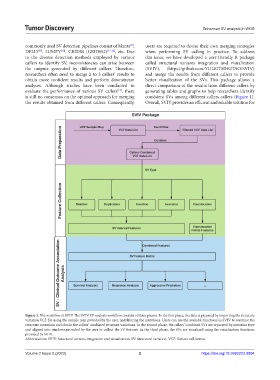
            is still no consensus on the optimal approach for merging   consistent SVs among different callers callers (Figure 1).
            the results obtained from different callers. Consequently,   Overall, SVIV provides an efficient and reliable solution for


            Figure 1. The workflow of SVIV. The SVIV SV analysis workflow consists of three phases. In the first phase, the data is prepared by importing the structure
            variation VCF file using the sample map provided by the user, and filtering the mutations. Users can use the available functions in SVIV to combine the
            structure mutations and obtain the callers’ combined structure variations. In the second phase, the callers’ combined SVs are separated by mutation type
            and aligned into windows provided by the user to collect the SV features. In the third phase, the SVs are visualized using the visualization functions
            provided by SVIV.
            Abbreviations: SVIV: Structural variants integration and visualization; SV: Structural variation; VCF: Variant call format.


            Volume 2 Issue 2 (2023)                         2                          https://doi.org/10.36922/td.0894

