


Page 64 - TD-2-2
P. 64
Tumor Discovery                                                            Enhanced SV analysis in WGS


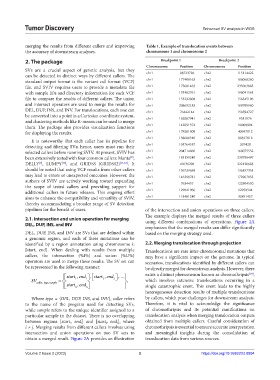
            merging the results from different callers and improving   Table 1. Example of translocation events between
            the accuracy of downstream analyses.               chromosome 1 and chromosome 2
            2. The package                                           Breakpoint 1             Breakpoint 2
                                                               Chromosome     Position  Chromosome    Position
            SVs are a crucial aspect of genetic analysis, but they
            can be detected in distinct ways by different callers. The   chr1  98723726  chr2         115114422
            standard  output format is  the variant call  format  (VCF)   chr1  177408163  chr2       106068260
            file, and SVIV requires users to provide a metadata file   chr1  175681463  chr2          235063885
            with sample IDs and directory information for each VCF   chr1    133482761  chr2          196041561
            file to compare the results of different callers. The union   chr1  153232808  chr2       156545196
            and intersect operators are used to merge the results for   chr1  208692183  chr2         108799960
            DEL, DUP, INS, and INV. For translocations, each one can   chr1   76442144  chr2          158594727
            be converted into a point in a Cartesian coordinate system,   chr1  162087941  chr2        9581976
            and clustering methods like K-means can be used to merge
            them. The package also provides visualization functions   chr1   142091374  chr2          16000994
            for displaying the results.                        chr1          179281809  chr2          43047012
                                                               chr1          138680310  chr2          80397812
              It is noteworthy that each caller has its pipeline for
            detecting and filtering SVs; hence, users must run their   chr1  103764557  chr2           207420
            selected callers before running SVIV. At present, SVIV has   chr1  204714860  chr2        168075552
            been extensively tested with four common callers: Manta ,   chr1  183159240  chr2         238798497
                                                        [8]
            DELLY ,  LUMPY ,  and GRIDSS  (GRIDSS2) [11,12] .  It   chr1      41036298  chr2          222120683
                  [9]
                           [10]
            should be noted that using VCF results from other callers   chr1  136739638  chr2         136157351
            may lead to errors or unexpected outcomes. However, the   chr1   146398781  chr2          172967853
            authors of SVIV are actively working toward expanding   chr1      7634457   chr2          122904530
            the scope of tested callers and providing support for
            additional callers in future releases. This ongoing effort   chr1  129841966  chr2        12950544
            aims to enhance the compatibility and versatility of SVIV,   chr1  118481240  chr2        33891457
            thereby accommodating a broader range of SV detection
            pipelines for the benefit of users.                of the intersection and union operations on three callers.
                                                               The example displays the merged results of three callers
            2.1. Intersection and union operation for merging   using  different  combinations  of operations.  Figure  2A
            DEL, DUP, INS, and INV
                                                               emphasizes that the merged results can differ significantly
            DEL, DUP, INS, and INV are SVs that are defined within   based on the merging strategy used.
            a genomic region, and each of these mutations can be
            identified by a region annotation using chromosome i:   2.2. Merging translocation through projection
            [start, end]. When dealing with results from multiple   Translocations are rare inter-chromosomal mutations that
            callers, the intersection (%I%) and union (%U%)    may have a significant impact on the genome. In typical
            operators are used to merge these results. The SV set can   scenarios, translocations identified by different callers can
            be represented in the following manner:            be directly merged for downstream analysis. However, there
                                                                                                           [14]
                                  startend ,   startend , ,   exists a distinct phenomenon known as chromothripsis ,

                                  ,
                                              ,


              SV callertypesample,  ,     1  1  2  2  ,     which involves extensive translocations occurring in a
                                starrt end,  n          single catastrophic event. This event leads to the highly

                                 n
                                                               heterogeneous detection results of multiple translocations
              Where type ∈ {DEL, DUP, INS, and INV}, caller refers   by callers, which pose challenges for downstream analysis.
            to the name of the program used for detecting SVs,   Therefore, it is vital to acknowledge the significance
            while sample refers to the unique identifier assigned to a   of chromothripsis and its potential ramifications on
            particular sample in the dataset. There is no overlapping   translocation analysis when merging translocation outputs
            between regions [start i,  end i] and [start j,  end j], where   obtained from multiple callers. Careful consideration of
            i ≠ j. Merging results from different callers involves using   chromothripsis is essential to ensure accurate interpretation
            intersection and union operations on two SV sets to   and meaningful insights during the consolidation of
            obtain a merged result. Figure 2A provides an illustration   translocation data from various sources.
            Volume 2 Issue 2 (2023)                         3                          https://doi.org/10.36922/td.0894

