


Page 147 - TD-3-4
P. 147
Tumor Discovery                                                     Primarily enucleated RB patient’s analysis


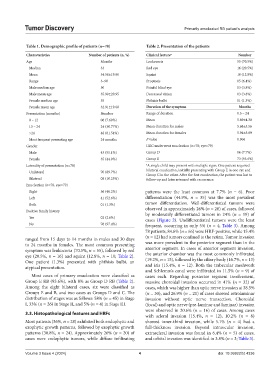
            Table 1. Demographic profile of patients (n=78)    Table 2. Presentation of the patients
            Characteristics            Number of patients (n, %)  Clinical feature a                  Number
            Age                             Months             Leukocoria                             55 (70.5%)
             Median                         33                 Red eye                                16 (20.5%)
             Mean                           34.56±19.90        Squint                                 10 (12.8%)
             Range                          3–90               Proptosis                              05 (6.4%)
             Male median age                30                 Painful blind eye                      03 (3.8%)
             Male mean age                  35.90±20.95        Decreased vision                       03 (3.8%)
             Female median age              35                 Phthisis bulbi                         01 (1.3%)
             Female mean age                32.91±19.68        Duration of the symptom                 Months
            Presentation (months)           Number             Range of duration                      0.5 – 24
             0 – 12                         06 (7.69%)         Mean                                   5.89±4.30
             13 – 24                        24 (30.77%)        Mean duration for males                5.68±3.56
             >24                            48 (61.54%)        Mean duration for females              5.94±5.09
             Most frequent presenting age   24 months          P value                                0.966
            Gender                                             IIRC underwent enucleation (n=78; eye=79)
             Male                           43 (55.1%)         Group D                                06 (7.7%)
             Female                         35 (44.9%)         Group E                                73 (93.6%)
            Laterality of presentation (n=78)                  a A single child may present with multiple signs. One patient required
             Unilateral                     70 (89.7%)         bilateral enucleation, initially presenting with Group E in one eye and
                                                               Group C in the other. After the first enucleation, the patient was lost to
             Bilateral                      08 (10.25%)        follow-up and later returned with recurrence.
            Enucleation (n=78, eye=79)
             Right                          36 (46.2%)         patterns were the least common at 7.7% (n = 6). Poor
             Left                           41 (52.6%)         differentiation (44.9%,  n = 35) was the most prevalent
             Both                           01 (1.3%)          tumor differentiation.  Well-differentiated tumors  were
            Positive family history                            observed in approximately 26% (n = 20) of cases, followed
                                                               by moderately differentiated tumors in 24% (n = 19) of
             Yes                            02 (2.6%)          cases (Figure  2). Undifferentiated tumors were the least
             No                             76 (97.4%)         frequent, occurring in only 5% (n = 4; Table 3). Among
                                                               78 patients, 84.6% (n = 66) were HRF-positive, while 15.4%
            ranged from 15 days to 14 months in males and 30 days   (n = 12) had tumors confined to the retina. Tumor invasion
            to 24  months in females. The most common presenting   was more prevalent in the posterior segment than in the
            symptom was leukocoria (70.5%, n = 55), followed by red   anterior segment. In cases of anterior segment invasion,
            eye (20.5%, n = 16) and squint (12.8%, n = 10; Table 2).   the anterior chamber was the most commonly infiltrated
            One patient (1.3%) presented with phthisis bulbi, an   (19.2%, n = 15), followed by the ciliary body (16.7%, n = 13)
            atypical presentation.                             and iris (15.4%, n = 12). Both the trabecular meshwork
                                                               and Schlemm’s canal were infiltrated in 11.5% (n = 9) of
              Most cases of primary enucleation were classified as   cases each. Regarding posterior segment involvement,
            Group E RB (93.6%), with 8% as Group D RB (Table 2).   massive choroidal invasion occurred in 41% (n = 32) of
            Among the eight bilateral cases, six were classified as   cases, which was higher than optic nerve invasion at 38.5%
            Groups E and B, and two cases as Groups D and C. The   (n = 30), and 26.9% (n = 21) of cases showed retrolaminar
            distribution of stages was as follows: 58% (n = 45) in Stage   invasion without optic nerve transection. Choroidal
            I, 33% (n = 26) in Stage II, and 5% (n = 4) in Stage III.  (focal) and optic nerve (pre-laminar and laminar) invasion
                                                               were observed in 20.6% (n = 16) of cases. Among cases
            3.3. Histopathological features and HRFs
                                                               with scleral invasion (15.4%,  n = 12), 10.2% (n = 8)
            Most patients (36%, n = 28) exhibited both endophytic and   showed inner-third invasion, while 5.1% (n = 4) had a
            exophytic growth patterns, followed by exophytic growth   full-thickness invasion. Beyond intraocular invasion,
            patterns (30.8%, n = 24). Approximately 26% (n = 20) of   extrascleral invasion was found in 6.4% (n = 5) of cases,
            cases were endophytic tumors, while diffuse infiltrating   and orbital invasion was identified in 3.8% (n = 3; Table 3).


            Volume 3 Issue 4 (2024)                         4                                 doi: 10.36922/td.4336

