


Page 170 - TD-3-4
P. 170
Tumor Discovery                                                Signet ring cell carcinoma of the urinary bladder


              Adenocarcinomas are the most prevalent histologic         A          B
            type that manifests as CUP. SRCC, a poorly differentiated
            aggressive subtype of adenocarcinoma, has been rarely
            reported to manifest as metastatic SRCC of unknown
            primary origin.  This case report describes a patient who
                        11
            presented with skeletal metastasis and circulating tumor
            cells (CTCs) exhibiting signet ring (SR) morphology. The
            diagnosis of SRCC was confirmed through bone marrow
            biopsy results. Despite an in-depth diagnostic workup, we
            were unable to establish the primary site of the tumor. The
            patient died 2 months after hospitalization. At autopsy, the
            urinary bladder was established as the primary site of the
            tumor.
            2. Case presentation
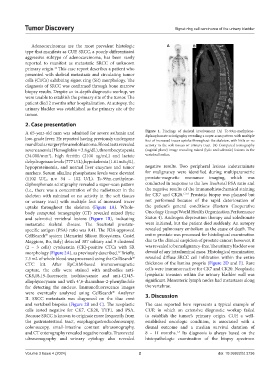
            A 65-year-old man was admitted for severe asthenia and   Figure  1.  Findings  of  skeletal  involvement  (A)  Tc-99m-methylene-
                                                               diphosphonate scintigraphy revealing a super-scan pattern with multiple
            low-grade fever. He reported having previously undergone   foci of increased tracer uptake throughout the skeleton, with little or no
            mandibular surgery for ameloblastoma. Blood tests revealed   activity in the soft tissues or urinary tract. (B) Computed tomography
            severe anemia (Hemoglobin = 3.8 g/dL), thrombocytopenia   (sagittal plane) image revealing mixed (lytic and sclerotic) lesions in the
            (34.000/mm ), high ferritin (2100  ng/mL) and lactate   vertebral bodies.
                      3
            dehydrogenase levels (777 U/L), hypokalemia (1.61 mEq/L),
            hypoproteinemia,  and  normal  liver  enzymes  and  tumor   negative  results.  Two  peripheral  lesions  indeterminate
            markers. Serum alkaline phosphatase levels were elevated   for malignancy were identified during multiparametric
            (1102 U/L, n.v. 34 – 102 U/L).  Tc-99m-methylene-  prostate-magnetic resonance imaging, which was
            diphosphonate scintigraphy revealed a super-scan pattern   conducted in response to the low free/total PSA ratio and
            (i.e., there was a concentration of the radiotracer in the   the negative results of the immunohistochemical staining
            skeleton with minimal or no activity in the soft tissues   for CK7 and CK20. 1,3-6  Prostatic biopsy was planned but
            or urinary tract) with multiple foci of increased tracer   not performed because of the rapid deterioration of
            uptake  throughout  the  skeleton  (Figure  1A).  Whole-  the patient’s general conditions (Eastern Cooperative
            body computed tomography (CT) revealed mixed (lytic   Oncology Group/World Health Organization Performance
            and sclerotic) vertebral lesions (Figure  1B), indicating   Status 4). Androgen deprivation therapy and zoledronate
            metastatic skeletal disease. The free/total prostate-  were initiated, but the patient died suddenly. An autopsy
            specific antigen (PSA) ratio was 9.41. The FDA-approved   revealed pulmonary embolism as the cause of death. The
            CellSearch  system (Menarini Silicon Biosystems, Castel   entire prostate was processed for histological examination
                    ®
            Maggiore, Bo, Italy) detected 387 solitary and 9 clustered   due to the clinical suspicion of prostate cancer; however, it
            (2 – 3  cells) cytokeratin (CK)-positive CTCs with SR   was revealed to be malignancy-free. The urinary bladder was
            morphology (Figure 2A), as previously described.  Briefly,   devoid of any intraluminal mass. Histological examination
                                                   12
            7.5 mL of whole blood was processed using the CellSearch    revealed diffuse SRCC cell infiltration within the entire
                                                         ®
            CTC kit. After EpCAM-based  immunomagnetic         thickness of the lamina propria (Figure 2D and E). Rare
            capture, the cells were stained with antibodies anti-  cells were immunoreactive for CK7 and CK20. Neoplastic
            CK8,18,19-fluorescein isothiocyanate and anti-CD45-  lymphatic  invasion  within  the  urinary  bladder  wall  was
            allophycocyanin and with 4′,6-diamidino-2-phenylindole   significant. Mesenteric lymph nodes had metastases along
            for detecting the nucleus. Immunofluorescence images   the vertebrae.
                                                 ®
            were  eventually  analyzed  using  CellSearch   Analyzer   3. Discussion
            II.  SRCC  metastasis  was  diagnosed  on  the iliac  crest
            and vertebral biopsies (Figure 2B and C). The neoplastic   The case reported here represents a typical example of
            cells tested negative for CK7, CK20, TTF1, and PSA.   CUP, in which an extensive diagnostic workup failed
            Because SRCC is known to originate more frequently from   to establish the tumor’s primary origin. CUP, a well-
            the  gastrointestinal  tract,  esophagogastroduodenoscopy,   established oncologic condition, is associated with a
            colonoscopy, small-intestine contrast ultrasonography,   dismal outcome and a median survival duration of
            and CT enterography revealed negative results. Transrectal   8 – 11  months.  Its diagnosis is always based on the
                                                                            1-4
            ultrasonography and urinary cytology also revealed   histopathologic examination of the biopsy specimen

            Volume 3 Issue 4 (2024)                         2                                 doi: 10.36922/td.3736

