


Page 175 - TD-3-4
P. 175
Tumor Discovery                                                     Sarcomatoid mesothelioma: A case report


            2. Case presentation

            A 50-year-old female with diabetes presented with acute-
            on-chronic right-sided upper back pain. Nine months
            before presentation, the patient experienced intermittent
            right-sided back pain without an identifiable trigger.
            Subsequently, non-productive cough and dyspnea on
            exertion developed  4  months  before  presentation.  Her
            symptoms progressed, and she developed progressively
            worsening  anorexia  and  nausea,  as  well  as  experiencing
            20 pounds of unintentional weight loss over 2 weeks, all
            of which prompted her to seek medical consultation and
            her admission to the hospital. Fevers, chills, and chest pain
            were  absent.  She  was  a  non-smoker  with  no  history  of
            secondhand smoke exposure. According to her, multiple
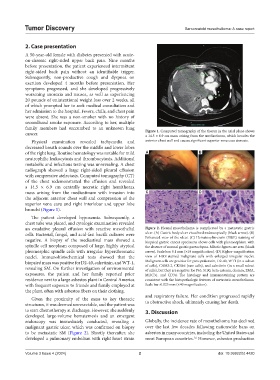
            family members had succumbed to an unknown lung    Figure 1. Computed tomography of the thorax in the axial plane shows
            cancer.                                            a 14.5 × 6.9 cm mass arising from the mediastinum, which invades the
              Physical examination revealed tachycardia and    anterior chest wall and causes significant superior vena cava stenosis.
            decreased breath sounds over the middle and lower lobes
            of the right lung. Routine hematology was notable for mild   A            B
            neutrophilic leukocytosis and thrombocytosis. Additional
            metabolic and infectious testing was unrevealing. A chest
            radiograph showed a large right-sided pleural effusion
            with compressive atelectasis. Computed tomography (CT)
            of the chest redemonstrated the effusion and revealed
            a 14.5 × 6.9  cm centrally necrotic right hemithorax
            mass arising from the mediastinum with invasion into   C                  D
            the adjacent anterior chest wall and compression of the
            superior vena cava and right interlobar and upper lobe
            bronchi (Figure 1).
              The patient developed hypoxemia. Subsequently, a
            chest tube was placed, and cytologic examination revealed
            an exudative pleural effusion with reactive mesothelial   Figure  2. Pleural mesothelioma is complicated by a metastatic gastric
            cells. Bacterial, fungal, and acid-fast bacilli cultures were   ulcer. (A) Gastric body ulcer visualized endoscopically (black arrow). (B)
                                                               Enhanced view of the ulcer. (C) Hematoxylin-eosin (H&E) staining of
            negative. A  biopsy of the mediastinal mass showed a   biopsied gastric cancer specimens shows cells with pleomorphism with
            spindle cell neoplasm composed of large, highly atypical   the absence of normal gastric parenchyma. Mitotic figures are seen (black
            pleomorphic spindle cells with irregular hyperchromatic   arrow). Scale bar: 0.1 mm (×10 magnification). (D) Higher-magnification
            nuclei. Immunohistochemical tests showed that the   view of H&E-stained malignant cells with enlarged irregular nuclei.
            biopsied mass was positive for D2-40, calretinin, and WT-1,   Malignant cells are positive for pancytokeratin, D2-40, WT1 (in a subset
                                                               of cells), CAM5.2, CK5&6 (rare cells), and calretinin (in a small subset
            revealing SM. On further investigation of environmental   of cells), but they are negative for P63, S100, beta-catenin, desmin, EMA,
            exposures, the patient and her family reported prior   MOC31, and CD34. The histology and immunostaining pattern are
            residence next to a large asbestos plant in Central America   consistent with the histopathologic features of metastatic mesothelioma.
            with frequent exposure to friends and family employed at   Scale bar: 0.025 mm (×40 magnification).
            the plant, often with asbestos fibers on their clothing.
                                                               and respiratory failure. Her condition progressed rapidly
              Given the proximity of the mass to key thoracic
            structures, it was deemed unresectable, and the patient was   to obstructive shock, ultimately causing her death.
            to start chemotherapy at discharge. However, she suddenly   3. Discussion
            developed  large-volume  hematemesis  and  an  emergent
            endoscopy was immediately conducted, revealing a   Globally, the incidence rate of mesothelioma has declined
            malignant gastric ulcer, which was confirmed on biopsy   over the last few decades following nationwide bans on
            to be metastatic SM (Figure  2). Shortly thereafter, she   asbestos in many countries, including the United States and
            developed a pulmonary embolism with right heart strain   most European countries.  However, asbestos production
                                                                                   1,6

            Volume 3 Issue 4 (2024)                         2                                 doi: 10.36922/td.4420

