


Page 129 - TD-4-1
P. 129
Tumor Discovery                                    MUTYH mutation in advanced rectal cancer with 5-FU resistance


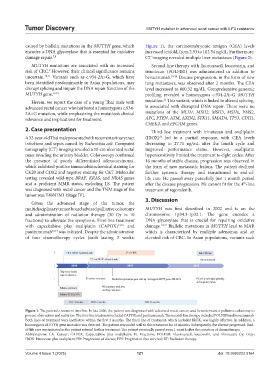
            caused by biallelic mutations in the MUTYH gene, which   Figure  1), the carcinoembryonic antigen (CEA) levels
            encodes a DNA glycosylase that is essential for oxidative   increased tenfold, from 2.93 to 102.54 ng/dL. Furthermore,
            damage repair. 7,8                                 CT imaging revealed multiple liver metastases (Figure 2).
              MUTYH mutations are associated with an increased   Second-line therapy with fluorouracil, leucovorin, and
                      9
            risk of CRC.  However, their clinical significance remains   irinotecan (FOLFIRI) was administered in addition to
            uncertain. 10,11  Variants such as c.934-2A>G, which have   bevacizumab. 18-20  Disease progression, in the form of new
            been identified predominantly in Asian populations, may   lung metastases, was observed after 2 months. The CEA
            disrupt splicing and impair the DNA repair function of the   level increased to 860.32 ng/dL. Comprehensive genomic
            MUTYH gene. 12,13                                  profiling revealed a homozygous c.934-2A>G  MUTYH
                                                                       21
              Herein, we report the case of a young Thai male with   mutation.  This variant, which is linked to altered splicing,
            advanced rectal cancer who harbored a homozygous c.934-  is associated with disrupted DNA repair. There were no
            2A>G mutation, while emphasizing the mutation’s clinical   mutations  of  the  MLH1,  MSH2,  MSH3,  MSH6,  PMS2,
            relevance and implications for treatment.          APC, PTEN, ATM, AXIN2, STK11, SMAD4, TP53, CDH1,
                                                               CHEK2, and EPCAM genes.
            2. Case presentation                                 Third-line treatment with irinotecan and oxaliplatin

            A 32-year-old Thai male presented with recurrent urinary tract   (IROX)  led to a partial response, with CEA levels
                                                                     22
            infections and sepsis caused by Escherichia coli. Computed   decreasing to 27.71  ng/mL after the fourth cycle and
            tomography (CT) imaging revealed a 10-cm ulcerated rectal   improved performance status. However, oxaliplatin
            mass invading the urinary bladder. Colonoscopy confirmed   hypersensitivity limited the treatment to eight cycles. After
            the  presence  of  poorly  differentiated  adenocarcinoma,   16 months of stable disease, progression was observed in
            which exhibited positive immunohistochemical staining for   the form of new metastatic lesions. The patient declined
            CK20 and CDX2 and negative staining for CK7. Molecular   further systemic therapy and transitioned to end-of-
            testing revealed wild-type  BRAF,  KRAS, and  NRAS genes   life care. He passed away peacefully just 1 month period
            and a proficient MMR status, excluding LS. The patient   after the disease progression. He cannot fit for the 4 -line
                                                                                                         th
            was diagnosed with rectal cancer and the TNM stage of the   treatment of regorafenib.
            tumor was T4bN1M1 (Stage IV).
              Given the advanced stage of the tumor, the       3. Discussion
            multidisciplinary tumor board advised palliative colostomy   MUTYH was first described in 2002 and is on the
            and administration of radiation therapy (30  Gy in 10   chromosome 1p34.3-1p32.1. The gene encodes a
            fractions) to alleviate the symptoms. First-line treatment   DNA glycosylase that is crucial for repairing oxidative
            with capecitabine  plus  oxaliplatin (CAPOX) 14,15  and   damage. 23,24  Biallelic mutations in MUTYH lead to MAP,
            panitumumab 16,17  was initiated. Despite the administration   which is characterized by multiple adenomas and an
            of four chemotherapy cycles (each lasting 3  weeks;   elevated risk of CRC. In Asian populations, variants such


            Figure 1. The patient’s treatment timeline. In late 2020, the patient was diagnosed with advanced rectal cancer, and he underwent a palliative colostomy to
            prevent obstruction and radiation. The first-line treatment included CAPOX and panitumumab. The second-line therapy included FOLFIRI and bevacizumab.
            Both lines of treatment were ineffective within the first 2 months. The third line of treatment, which included IROX, was highly effective. In addition, a
            homozygous MUTYH gene mutation was detected. The patient responded well to this treatment for 16 months. Subsequently, the disease progressed. End-
            of-life care was initiated as the patient refused further treatment. The patient eventually passed away 1 month after the cessation of chemotherapy.
            Abbreviations: CA: Cancer; CAPOX: Capecitabine plus oxaliplatin; Fr: Fractions; FOLFIRI: Fluorouracil, leucovorin, and irinotecan; Gy; Gray;
            IROX: Irinotecan plus oxaliplatin; PD: Progression of disease; PFS: Progression-free survival; RT: Radiation therapy.


            Volume 4 Issue 1 (2025)                        121                                doi: 10.36922/td.5164

